
“Montessori doesn’t focus on managing behaviors — it shapes the conditions around them.” At first glance, the statement sounds bold—some may even say unrealistic. After all, anyone who works in dementia care knows this reality: there are moments when behaviors must be managed.
Why This Matters
In dementia care, behaviors are often treated as disruptions. Something to correct, redirect, or control. Over time, this approach can leave both residents and staff feeling frustrated, exhausted, or stuck in cycles that never quite resolve.
A Montessori-informed approach asks a different question:
What conditions are present when this behavior occurs?
This shift doesn’t ignore safety, accountability, or clinical responsibility.
It broadens the lens so we’re not only reacting — we’re designing more thoughtfully from the start.
Behaviors Are Information
Behaviors don’t appear randomly.
They are responses to what a person is experiencing in that moment.
Pain, confusion, boredom, fear, overstimulation, loss of control, unmet social needs — all of these can surface as behaviors when verbal communication becomes difficult.
When we treat behavior as information rather than defiance, the work changes. We move from stopping behavior to understanding it.
Schedules. Documentation. Risk tolerance. Staffing models. Language.
These all shape behavior long before a caregiver enters the room.
The Limits of Managing
Traditional “management” approaches often rely on:
- correcting actions,
- enforcing routines,
- increasing prompts or reminders,
- or applying consequences when things don’t go as planned.
These strategies may work temporarily, but they rarely lead to lasting change.
Why? Because they focus on the surface response rather than the underlying experience.
Managing behavior asks, “How do we make this stop?”
Designing conditions asks, “What needs to change so this doesn’t need to happen?”
Design Is Not About Control
Designing conditions does not mean:
- removing structure,
- lowering expectations,
- or allowing chaos.
In fact, good design adds clarity. Clear cues, predictable routines, respectful pacing, meaningful roles, and environments that support remaining abilities all reduce the need for reactive interventions later.
Design is proactive. It anticipates needs before distress escalates.
Everyday Conditions Matter
Small, everyday elements quietly shape experience:
- how a request is phrased,
- whether someone is rushed or invited,
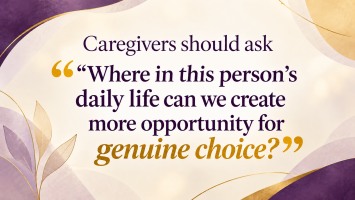
- how much choice is real versus implied,
- whether the environment feels noisy, crowded, or calm,
- whether a person feels useful, included, or watched.
None of these appear dramatic on their own.
Together, they make the difference between cooperation and resistance, engagement and withdrawal.
From Individual Moments to Systems
While individual interactions matter, sustainable change doesn’t rely on individual effort alone.
When expectations live only in people’s heads — or depend on “good staff” — progress is fragile. Turnover, fatigue, and inconsistency quickly undo it.
Design thinking extends beyond moments into systems:
- how decisions are made,
- how information is shared,
- how follow-up happens,
- and how learning is reinforced.
This is where leadership plays a critical role.
Leadership Shapes Conditions Too
Leadership decisions influence:
- how much autonomy staff have,
- whether reflection is encouraged or avoided,
- how problems are explored,
- and whether learning translates into daily practice.
When leaders focus only on outcomes, staff often become reactive.
When leaders focus on conditions, teams become more thoughtful, aligned, and resilient.
This isn’t about micromanagement.
It’s about visibility, ownership, and intentional design.
Leadership systems either:
- reduce conditions that create distress
or - quietly reproduce them
Schedules. Documentation. Risk tolerance. Staffing models. Language.
These all shape behavior long before a caregiver enters the room.
Design Does Not Mean Perfection
A Montessori-informed approach does not expect flawless implementation.
It expects:
- curiosity instead of blame,
- adjustment instead of rigidity,
- reflection instead of defensiveness.
Mistakes are information.
They show us where conditions need to be revisited.
What Changes When Conditions Change
When environments and systems are better aligned:
- residents feel safer and more respected,
- staff feel less pressured to “control” situations,
- behaviors become less frequent or intense,
- and responses become calmer and more consistent.
Not because dementia disappears — but because distress has fewer places to take hold.
Bringing This Perspective Into Daily Work
This approach asks teams to pause and ask:
- What is happening before the behavior?
- What cues might be confusing or overwhelming?
- Where is choice present — and where has it quietly disappeared?
- What assumptions are being made about compliance, timing, or ability?
These questions don’t slow care down.
They make it more effective.
“Montessori doesn’t focus on managing behaviors.
It shapes the conditions around them.”
Not because reality is simple — but because outcomes are shaped by design.
Here’s the perfect program to fully understand the concept…click here for full details and registration information.
For groups in LTC and other residences and community organizations offering cognitive care should delve into this further. Click here to check this program.
Can’t attend in person, look into the online version… Montessori Dementia Training: Making Daily Care Work
Or, any of these online sessions:
1.) Resident Choice Is a System, Not a Suggestion
Save 20% by registering for both parts together.⇓
Register for Resident Choice: Part One & Part Two – $88
2.) How to Create & Present Purposeful Activities
3.) How to Form Dementia-Friendly Resident Committees: Where Everyone Belongs