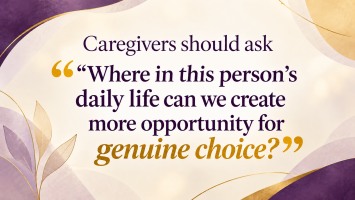
Register today for this brand new program: Resident Choice: Part One and Part Two. Resident Choice is not a “nice-to-have” in dementia care — it is a foundational element of dignity, cooperation, and emotional safety. Yet in many care settings, choice is unintentionally removed as dementia progresses, replaced by schedules, routines, and task-driven care.
Resident Choice is the intentional design of care, communication, routines, and environments so that residents can continue to express preferences, participate in decisions, and experience agency in daily life — using abilities that remain accessible as dementia progresses.
Resident Choice: Part One ⇒ Tuesday, November 3, 2026 – 10:00 AM – 12:00 PM
Resident Choice: Part Two ⇒ Tuesday, November 17, 2026 – 10:00 AM – 12:00 PM
Part Two is designed to build on Part One.
>> Register for both together and receive 20% off the combined price.
Register for Resident Choice: Part One – $55/Person
Register for Resident Choice: Part Two – $55/Person
Save 20% by registering for both parts together.⇓
Register for Resident Choice: Part One & Part Two – $88
Resident Choice – Parts One and Two is a comprehensive, practice-focused training designed to help care teams understand why choice matters, where it lives in daily care, and how to offer it in ways that actually work for people living with dementia.
This training goes far beyond theory. It equips staff with concrete strategies they can use immediately — during meals, activities, personal care, communication, and documentation — to support autonomy without increasing workload or compromising safety.

Training for Dementia Care Teams
Part One: Foundations, Dining, and Activities
Part One establishes the core mindset shift required for effective choice-based dementia care.
Staff learn the critical difference between independence and autonomy, and why preserving autonomy remains possible — and essential — even as physical and cognitive abilities change. The training reframes “responsive behaviors” as signals of lost control rather than refusal or noncompliance, helping staff see care interactions through a more compassionate and effective lens.
From there, the session moves into where choice already exists in everyday life, including:
-
mealtimes
-
activities and routines
-
clothing and grooming
-
social roles and contribution
Rather than adding new tasks, staff learn how to recognize and intentionally invite choice in moments that are already part of their day.
Dining: Where Choice Makes an Immediate Impact
Dining is explored in depth as a high-impact opportunity for choice. Staff learn why visual menus, demonstration, pacing, and nonverbal communication reduce anxiety, improve appetite, and increase cooperation. The training explains why pictures work better than words and why slowing down often saves time in the long run.
Activities: Identity Over Attendance
Activities are reframed as expressions of identity rather than scheduled participation. Staff learn why activity calendars do not guarantee engagement, how offering options instead of expectations increases self-initiation, and why meaningful roles are often more powerful than programmed activities. The emphasis is on purpose, ownership, and belonging, not “keeping busy.”
By the end of Part One, participants understand that choice is not about slowing care down — it is about preventing escalation, reducing refusals, and creating smoother, more respectful interactions throughout the day.
(Scroll for Part Two and Who Should Attend)
Resident Choice: Part One ⇒ Tuesday, November 3, 2026 – 10:00 AM – 12:00 PM
Resident Choice: Part Two ⇒ Tuesday, November 17, 2026 – 10:00 AM – 12:00 PM
Part Two is designed to build on Part One.
>> Register for both together and receive 20% off the combined price.
Register for Resident Choice: Part One – $55/Person
Register for Resident Choice: Part Two – $55/Person
Save 20% by registering for both parts together.⇓
Register for Resident Choice: Part One & Part Two – $88
Part Two: Daily Care, Communication, and Documentation
Part Two builds directly on this foundation and moves into the most sensitive — and most challenging — areas of care.
Choice in Personal and Intimate Care
Staff explore how choice can be preserved during dressing, bathing, grooming, and routines that involve physical assistance. The training addresses common triggers for distress and provides practical ways to offer control through timing, sequencing, sensory adjustments, and language — even when care must occur.
Rather than positioning choice as optional, Part Two makes it clear: how care is offered often matters more than the care itself.
Communication That Supports Success
Participants learn how communication style determines whether care interactions escalate or flow smoothly. The training emphasizes:
-
fewer words and clearer signals
-
demonstration over explanation
-
invitation language instead of directives
-
pacing, tone, and nonverbal cues
Staff practice reframing common care phrases into language that supports autonomy without sounding scripted or artificial.
Documentation That Reflects Person-Directed Care
A critical component of Part Two is documentation. Staff learn how to document choice clearly and professionally, ensuring that autonomy-supportive care is visible to the entire team and to credentialing bodies. The training clarifies what to document, what to avoid, and how small wording changes can protect both residents and staff.
This section bridges daily practice with organizational accountability, making Montessori-informed care visible, measurable, and sustainable.
Why This Training Works
What sets Resident Choice apart is its depth, clarity, and practicality.
This is not a motivational session or a surface-level overview. It is a carefully structured learning experience that:
-
respects the realities of frontline dementia care
-
avoids unrealistic expectations
-
provides language, patterns, and decision-making tools staff can use immediately
-
aligns with Montessori-Inspired Lifestyle® principles and credentialing standards
Participants leave with a clear understanding of what to do differently tomorrow, not just what to believe.
The Result: Better Care, Smoother Days, Stronger Teams
When choice is offered well:
-
residents feel safer and more respected
-
cooperation increases
-
responsive behaviors decrease
-
staff experience less resistance and stress
Care becomes more collaborative, more human, and more sustainable.
Resident Choice – Parts One and Two gives care teams the tools
to move beyond task completion and toward
truly person-directed dementia care — without adding complexity or burden.
This is training that changes how staff see their work — and how residents experience their day.
Who Should Attend?
It’s ideal for anyone who supports individuals living with dementia—at any stage and in any setting.
Perfect for professionals working in:
-
Long-term care homes and senior residences
-
Adult day programs and community organizations
-
Home care and family support services
-
Health and social care leadership roles
Including (but not limited to):
-
Personal Support Workers (PSWs), Orderlies
-
Activity, Recreation & Life Enrichment Coordinators
-
Therapists, Social Workers, Family Support Workers
-
Dietitians, Community Care Workers, Home Care Aides
-
Speech-Language Pathologists
-
Nurse Managers, Directors of Care, Support Managers/Specialists
- Volunteers, family members and care partners
Next sessions…

Resident Choice: Part One ⇒ Tuesday, November 3, 2026 – 10:00 AM – 12:00 PM
Resident Choice: Part Two ⇒ Tuesday, November 17, 2026 – 10:00 AM – 12:00 PM
Part Two is designed to build on Part One.
>> Register for both together and receive 20% off the combined price.
Register for Resident Choice: Part One – $55/Person
Register for Resident Choice: Part Two – $55/Person
Save 20% by registering for both parts together.⇓