Caregiver Documentation: Write What Happened, Not What You Think It Means
– In dementia care, caregiver documentation is more than a record of the past. It is a communication tool for the next caregiver, the next shift, the care team, and sometimes the family or leadership team. Done well, documentation helps everyone understand what happened, what may have contributed to it, what helped, and what should be tried next.
Done poorly, documentation can unintentionally label a resident, blame a resident, or leave the next caregiver with very little useful information.
One of the most important shifts caregivers can make is this:
Document what happened — not what you perceived, assumed, or concluded happened.
That may sound simple, but it changes everything.
The Problem With Labels
Care notes often include phrases such as:
“Mr. Jones was aggressive.”
“Mrs. Lee was difficult today.”
“Mr. Ahmed was showing behaviors.”
“Resident was uncooperative.”
“Resident refused care.”
These phrases are common, but they are not very helpful. They tell us very little about what actually happened. They also place the problem inside the resident, instead of helping the team understand the situation.
For example, saying “Mr. Jones was aggressive” does not tell the next caregiver:
- what Mr. Jones did
- what was happening just before
- who was present
- what care task was being attempted
- what words were used
- whether he seemed frightened, confused, rushed, cold, tired, overwhelmed, or in pain
- what helped the situation settle
- or what should be done differently next time
The word “aggressive” may be the caregiver’s interpretation, but it is not a description. It is a conclusion.
In dementia care, conclusions can be dangerous if they become labels. Once a resident is described repeatedly as “aggressive,” “resistant,” or “difficult,” staff may begin approaching that person with tension, defensiveness, or caution. The resident then senses that energy, and the cycle continues.
Better documentation helps break that cycle.
Write the Scene, Not the Judgment
Good documentation should briefly describe the observable facts.
Instead of writing:
“Mr. Jones was aggressive during morning care.”
A more useful note might say:
“During morning care, Mr. Jones pushed the caregiver’s hand away when she attempted to remove his sweater. He said, ‘Leave me alone.’ Care was paused for five minutes. When the caregiver returned and offered him a choice between the blue shirt and green shirt, he allowed assistance with dressing.”
This note gives the next caregiver something to work with.
It tells them:
- the situation was morning care
- the trigger may have been removing clothing
- Mr. Jones used words and physical action to stop the task
- pausing helped
- offering a choice helped
- and the task was completed after the approach changed
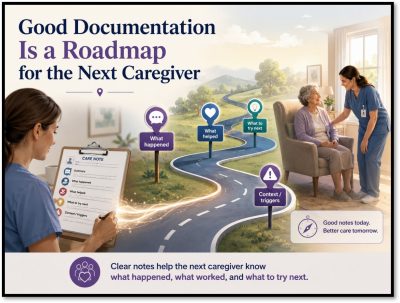
That is not just documentation. That is a roadmap.
Documentation Should Help the Next Caregiver Succeed
Every note should answer this question:
“What does the next caregiver need to know in order to approach this resident more successfully?”
Caregivers do not need long essays. They need clear, practical information that helps them understand the person and the situation.
Useful documentation includes:
What happened?
Describe the resident’s words, actions, expressions, movements, or changes in participation.
What was happening just before?
Was care being provided? Was the resident being rushed? Was there noise? Was the resident being touched? Was there a transition? Was a demand being placed on the person?
What did staff try?
Did staff pause, step back, offer a choice, simplify the task, change caregivers, use a visual cue, offer reassurance, reduce noise, or come back later?
What helped?
This may be the most important part. The next caregiver needs to know what worked.
What should be tried next time?
A good note should make the next attempt easier, calmer, and more person-centered.
From “Refused” to “Not Yet Successful”
 The phrase “refused care” is another common documentation habit. Sometimes it may be required language in certain systems, but by itself it is incomplete.
“Refused care” sounds final. It can imply that the resident simply would not cooperate.
But in dementia care, what looks like refusal may actually be communication.
The person may not understand what is happening. They may feel rushed. They may not recognize the caregiver. They may be embarrassed, cold, tired, overstimulated, in pain, or frightened. They may understand the task differently than staff do.
Instead of only writing:
“Resident refused shower.”
A more helpful note would be:
“When invited to shower at 8:30 a.m., Mrs. Patel said, ‘No, I already did that,’ and walked away from the bathroom. Staff offered reassurance and returned at 10:15 a.m. with towels visible and a warm robe ready. Mrs. Patel agreed to wash at the sink but did not want a full shower.”
This note tells the next caregiver much more. It shows that the first approach did not work, but another version of care was partly successful.
That matters.
Responsive Behaviors Are Communication
In dementia care, responsive behaviors are often responses to something happening in the environment, the approach, the task, the timing, the person’s internal state, or the way the situation is being understood.
Documentation should help the team look for patterns.
For example:
Does the resident become distressed during personal care?
Only with certain tasks?
Only at certain times of day?
Only when approached from behind?
Only when there are multiple staff members present?
Only when rushed?
Only when the room is noisy?
Only when choices are removed?
Only when pain may be present?
Labels do not reveal patterns. Descriptions do.
The goal is not to write a perfect clinical report. The goal is to capture enough detail so the team can learn from what happened.
Better Words Lead to Better Care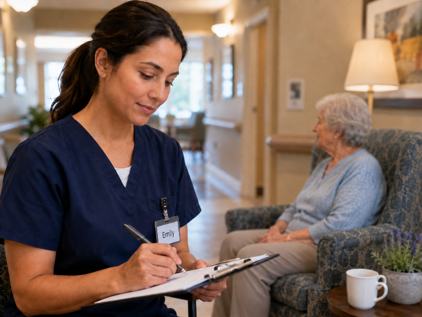
Here are some examples of how documentation can be improved.
Instead of:
“Resident was aggressive.”
Write:
“Resident raised his voice, said ‘Get out,’ and pushed the towel away when staff attempted to begin bathing.”
Instead of:
“Resident was combative.”
Write:
“Resident grabbed the caregiver’s sleeve when transfer was started and said, ‘Stop.’ Staff paused and explained each step before continuing.”
Instead of:
“Resident was non-compliant.”
Write:
“Resident did not follow the request to come to the dining room. She remained seated and said she was waiting for her mother.”
Instead of:
“Resident was difficult all afternoon.”
Write:
“Between 2:00 p.m. and 4:00 p.m., resident walked repeatedly to the exit door and asked when the bus was coming. Staff redirected her to folding towels for 15 minutes, which appeared calming.”
Instead of:
“Resident showed behaviors.”
Write:
“Resident called out ‘Help me’ several times after lunch while seated in the lounge. When staff sat beside her and offered a drink, she stopped calling out and remained calm for approximately 20 minutes.”
These notes are more respectful, more accurate, and more useful.
Documentation Should Not Sound Like Blame
Caregiver documentation should never make the resident sound like the problem.
A resident living with dementia is often doing the best they can with a changing brain, changing abilities, and an environment that may not always make sense to them.
The purpose of documentation is not to prove that the resident was wrong. The purpose is to help the team understand what the resident may have been communicating and how care can be adjusted.
That does not mean caregivers should minimize risk or avoid reporting serious incidents. Safety matters. Accuracy matters. But even serious situations should be documented with clear, observable language.
For example:
“Resident struck another resident” is more accurate than “Resident became violent.”
But it is even more helpful to add context:
“Resident struck another resident on the arm after the other resident picked up his newspaper. Staff separated the residents. Mr. Jones appeared upset and said, ‘That’s mine.’ He settled after the newspaper was returned and staff offered him a seat in the quiet lounge.”
This gives the team information that may prevent the same situation from happening again.
Good Documentation Captures the Approach
In Montessori-inspired dementia care, the care approach matters deeply. The environment, timing, language, pacing, choices, cues, and roles all influence how a resident responds.
That means documentation should include not only what the resident did, but also what staff did.
For example:
“Staff approached from the front, used resident’s name, showed the toothbrush, and asked, ‘Would you like to brush your teeth before or after washing your face?’ Resident chose toothbrush and completed task with verbal cueing.”
This note is valuable because it records a successful approach.
We often document when something goes wrong, but we should also document what works. Successful approaches should not disappear when one caregiver leaves the room. They should become shared knowledge.
A Simple Documentation Formula
Caregivers can use a simple structure:
- What happened?
- What was happening before it happened?
- What did we try?
- What helped?
- What should the next caregiver know?
For example:
“At 7:45 a.m., Mr. Jones pushed the washcloth away and said, ‘No’ when staff attempted face washing before breakfast. Staff paused, offered breakfast first, and returned after he had eaten. He then accepted face washing when given the cloth to hold and start himself. Next shift: try offering the cloth to Mr. Jones first and allow him to begin the task.”
This is brief, practical, and person-centered. It also gives the next caregiver a clear path forward.
Documentation Is Part of the Care Plan
Care documentation should not be treated as paperwork separate from care. It is part of care.
When caregivers document clearly, they help the whole team:
- Reduce repeated distress
- Avoid unsuccessful approaches
- Recognize patterns
- Share successful strategies
- Support consistency
- Protect resident dignity
- Improve safety
A good note can prevent the next difficult moment.
It can help the next caregiver avoid repeating an approach that already failed. It can also help them use an approach that has already worked.
That is why documentation should function like a roadmap.
Not a label. Or a complaint. Not a judgment.
A roadmap.
The Standard: Could Another Caregiver Use This?
Before finishing a note, caregivers can ask themselves:
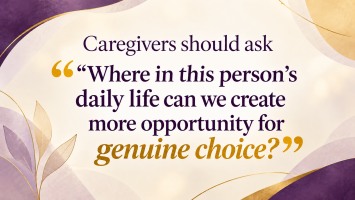
“Could another caregiver read this and know what to do differently or what to try next?”
If the answer is no, the note may need one more sentence.
For example, this note is incomplete: “Resident was upset during care.” This note is better:
“Resident became tearful when staff attempted to change her blouse. Staff paused, offered privacy, and asked if she wanted the blue blouse or the pink blouse. Resident chose the pink blouse and accepted assistance after a few minutes.”
Now the next caregiver knows something useful.
In dementia care, the words we write shape the care that follows.
When documentation labels a resident, it can close down curiosity.
When documentation describes what happened, it opens the door to understanding.
Caregivers do not need to write long notes. They need to write useful notes.
The goal is to help the next person walk in better prepared, with more insight, more respect, and a clearer idea of how to support the resident successfully.
Because good documentation does more than record what happened.
It helps shape what happens next.