
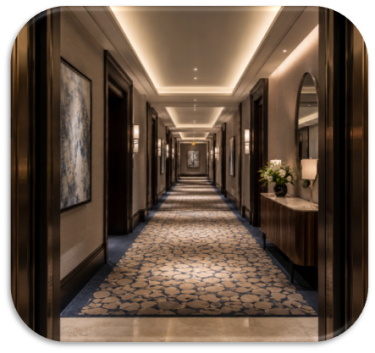
In dementia care, the environment speaks; it is never silent. Every hallway, doorway, sign, chair, dining table, bathroom, closet, and activity space is communicating something.
Sometimes it says, “You are safe.” or “This is where you belong.” or “Come this way.” Sometimes it says, “This is too much. I do not know what to do here.”
The challenge is that people living with dementia may not always receive the message the way we intended.
A sign, a symbol, a hallway, or a room setup may seem obvious to staff because staff understand the building, the routine, and the purpose of the space. But for a person living with dementia, the environment may no longer provide clear information. What once made sense may now feel confusing, unfamiliar, or even threatening.
That is why the environment matters so much. It is not just background. It is part of the care.
Imagine This Happened to You
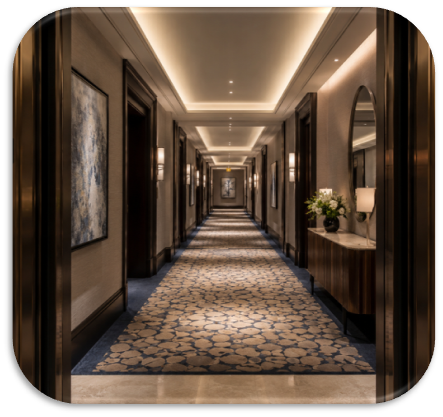 Imagine you are staying in a hotel.
You leave your room and step into the hallway. Normally, this would be simple. You would look for the elevator sign, follow the arrows, read the room numbers, recognize the washroom symbol, and find your way to the lobby.
But now imagine that, suddenly, none of the icons or symbols make sense.
The elevator symbol is just a strange shape. The arrows no longer tell you which way to go. The room numbers do not help you orient yourself. The sign for the washroom is unclear. The long hallway looks the same in both directions. Every door looks alike.
You are not being difficult or refusing to cooperate. You’re not “wandering for no reason.”
You are trying to understand where you are.
Perhaps you’ll walk back and forth, or open the wrong door. You might ask the same question more than once. If someone rushes you and says “it’s right here” you may become anxious or frustrated when it is not obvious to you at all.
From the outside, your behaviour may look like the problem.
But the real problem is that the environment stopped speaking your language.
This Is What Can Happen in Dementia
For many people living with dementia, the world becomes harder to read.
A bathroom door may not look like a bathroom door. A dining room may not clearly say, “This is where we eat.” A closet full of clothing may not clearly say, “Choose something to wear.” A hallway may not offer enough clues about where to go next. A busy lounge may not feel inviting; it may feel overwhelming.
Even familiar places can become difficult when memory, vision, attention, sequencing, or interpretation are affected.
This is why a person may:
- stand in front of a door and not open it
- walk past the dining room without realizing lunch is being served
- resist personal care in a bathroom that feels cold, cluttered, or confusing
- become unsettled in a hallway where every exit looks the same.
The person is often responding to what the environment is saying — or failing to say.
Although the phrase ‘the environment as the third teacher’ is most often associated with the Reggio Emilia approach, it fits closely with Montessori’s idea of the prepared environment. Montessori taught that the environment should be intentionally arranged so it supports independence, guides action, and reduces the need for constant verbal instruction.
The Environment Speaks – It Can Support or Disable
A supportive environment helps a person use the abilities they still have.
It provides cues. It reduces guesswork. It makes the next step easier to see. It allows the person to participate with less explanation from staff.
For example, a bathroom with a clear sign, good lighting, a contrasting toilet seat, and visible towels is giving information. It is saying, “This is the bathroom. This is where to sit. This is what comes next.”
A dining table with one place setting, a contrasting plate, and the food clearly visible is also speaking. It is saying, “This is your place. This is your meal. You can begin here.”
A resident room with familiar objects, a visible name, and meaningful personal items is saying, “This is your space. You belong here.”
But the opposite can also happen.
A cluttered counter can say, “There are too many things here.”
A blank door can say nothing at all.
A noisy room can say, “This is not safe.”
A hallway with identical doors can say, “You are lost.”
A sign that is too small, too abstract, or placed too high can say, “You are on your own.”
In dementia care, silence from the environment often creates extra work for the person and extra pressure for the caregiver.
 When Words Have to Do the Environment’s Job
When the environment is unclear, staff often have to explain what the space is not showing clearly.
A caregiver may say:
“This is the bathroom.”
“Your room is down the hall.”
“Lunch is over here.”
“You can sit here.”
“Your sweater is in the closet.”
“We already did that.”
These are not long instructions. In fact, many of them are short and well-intended.
But for a person living with dementia, even a short instruction may not be enough if the environment does not support the message. “Down the hall” may not help if every hallway looks the same. “Over here” may not help if the person cannot easily see where “here” is. “Your sweater is in the closet” may not help if the closet is crowded, the door is closed, or the person no longer recognizes that this is where clothing is kept.
The problem is not that staff are talking too much.
The problem is that words are being asked to carry too much of the load.
A clearer environment reduces the need for repeated explanation. A visible bathroom sign, a familiar photo by the resident’s room, a chair pulled slightly out at the dining table, or two sweaters placed where they can be seen may communicate more effectively than another verbal reminder.
In dementia care, words still matter. Tone matters. Approach matters. But the environment should help the words make sense.
Good Environmental Cues Are Not Childish
One important point: dementia-friendly does not mean childish.
Clear signs, contrast, familiar objects, and visual cues are not about treating adults like children. They are about making the environment readable.
Adults without dementia rely on environmental cues all day long. We follow arrows in airports, look for exit signs in theatres… we use icons on our phones. We recognize washrooms, elevators, reception desks, and restaurants because the environment gives us information.
The difference is that people living with dementia may need cues that are more concrete, more visible, more familiar, and more consistent.
That is not childish. It is respectful.
It says, “We are not going to make you struggle to understand this place. We are going to help the space support you.”
The Environment Should Reduce the Need to Guess
A well-prepared environment answers questions before the person has to ask them.
- Where am I?
- Where do I go?
- What is this for?
- What am I supposed to do here?
- Is this mine?
- Am I safe?
- Do I belong?
When the environment answers those questions clearly, people often feel more settled. They may need fewer verbal prompts. They might participate more easily and experience less frustration. Staff may also feel less pressure because the space is helping instead of working against them.
This does not mean the environment solves everything. Dementia care still requires skilled, compassionate, flexible caregivers. But the environment can make their work easier and the resident’s day less confusing.
What This Looks Like in Practice
A dementia-supportive environment might include:
- Clear signs with both words and pictures.
- Good contrast between important objects and the background.
- Personalized room cues, such as a name, photo, or familiar object.
- Uncluttered spaces that show the next step.
- Visible items that invite participation, such as folded towels, gardening tools, or activity materials.
- Consistent placement of important objects.
- Warm lighting and reduced visual noise.
- Dining setups that clearly show where to sit and what to start with.
- Bathrooms that are easy to identify and use.
- Hallways with meaningful landmarks, not just repeated doors.
These are not decorative extras. They are communication tools.
The Message We Want the Environment to Send
In long-term care, the environment should not simply look nice. The environment must work.
It should help:
- residents understand
- support independence
- reduce uncertainty
- make routines easier to follow.
It should cue preserved abilities and help caregivers approach with less pressure and more success.
The environment should say:
- “You are safe.”
- “You are welcome here.”
- “This is familiar.”
- “This is what happens next.”
- “You can do part of this.”
- “You belong.”
When the environment speaks clearly, care becomes less about correcting the person and more about supporting the moment.
And in dementia care, that can make all the difference.