
There is an old saying that still belongs in dementia care: Slow and steady wins the race. It sounds simple. Maybe even too simple. But in many care settings, it may be exactly the reminder we need.
Because somewhere along the way, meaningful activity can start to look like movement for the sake of movement.
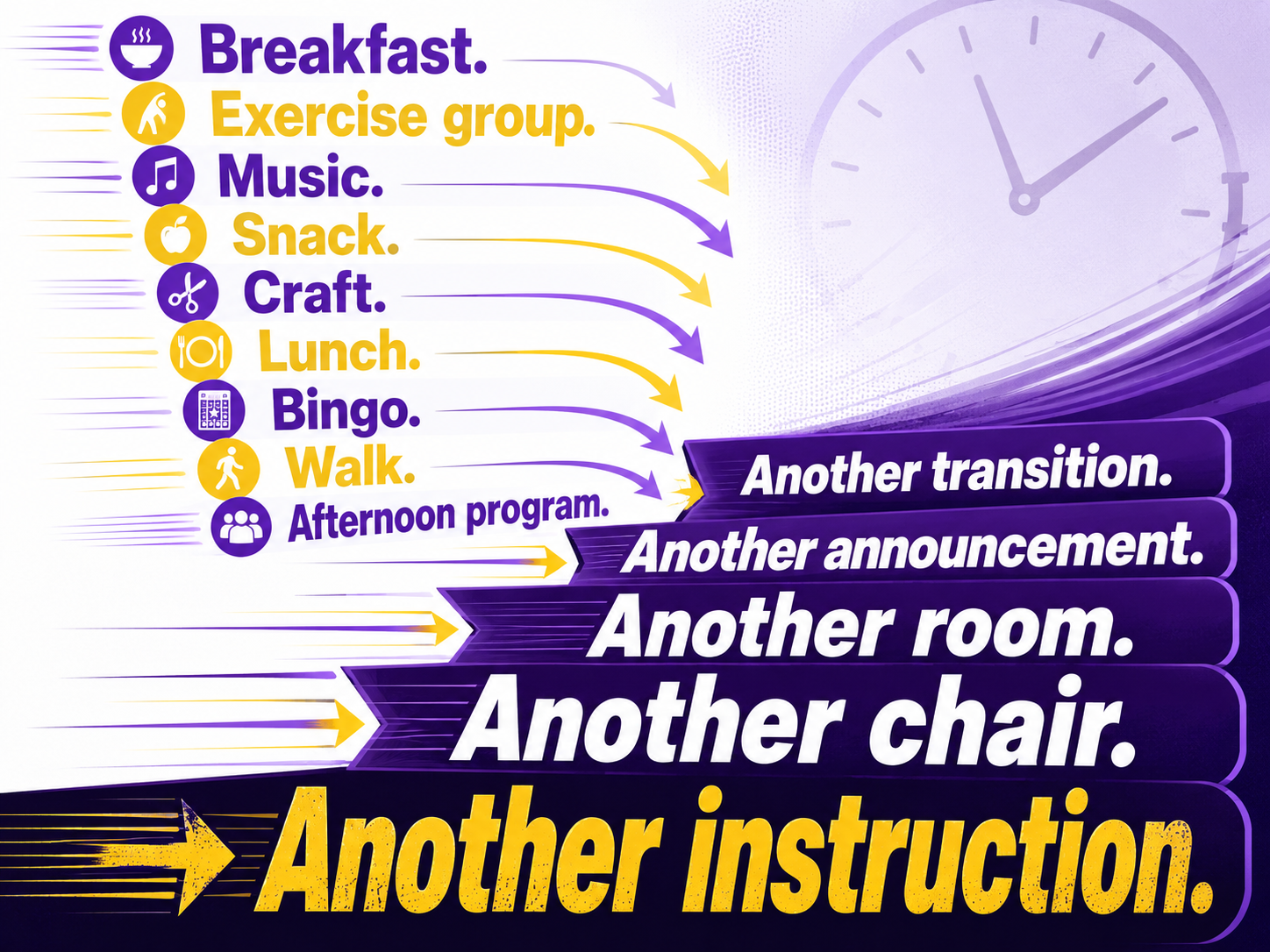
Breakfast, exercise group, music, snack, craft, lunch, bingo, walk, afternoon program, another transition, another announcement, another room, another chair, another instruction…
On paper, the day looks full.
But for a person living with dementia, it may not feel full in a good way. It may feel rushed, confusing, noisy, and exhausting.
And for staff, it can feel like a race they can never quite win.
The goal becomes getting people to the activity, through the activity, and then on to the next one. But the real goal should be different.
The goal is not to keep people busy.
The goal is to help people feel capable, connected, useful, and calm.
That takes time.
Activity is not the same as purpose.
In dementia care, we often use the word “activity” to describe almost everything that happens outside personal care. But not every activity creates meaning.
An activity can fill time.
A purposeful activity fills a need.
It may:
- support identity
- invite contribution
- use a preserved skill
- create a familiar rhythm
- give the person a reason to participate
- allow them to be helpful instead of simply entertained
That is a very different starting point.
For example, folding towels is not just folding towels if the person spent years caring for a home, raising children, working in laundry, helping others, or taking pride in order.
Watering plants is not just watering plants if the person loved gardening.
Sorting papers is not just sorting papers if the person was organized, detail-oriented, or enjoyed office work.
Stirring batter, wiping a table, setting out napkins, matching socks, arranging flowers, sorting recipe cards, placing hymn books, checking seed packets, polishing cutlery, or helping prepare a tray can all become meaningful when they connect to who the person has been.
Purposeful activity does not have to be impressive.
It has to make sense to the person.
Rushing removes the meaning
When staff feel pressured to move everyone from one activity to the next, the experience can become task-based instead of person-centred.
The person may barely understand where they are going before they are being asked to sit down. They may barely settle into one group before they are encouraged to move to another. They may need more time to process the invitation, the environment, the materials, and the social expectations.
Then we wonder why they resist, withdraw, wander away, say no, or become upset.
Sometimes the problem is not the activity. Sometimes the problem is the pace.
People living with dementia often need more time to transition; to understand, more time to begin and to feel successful. A rushed invitation can feel like pressure. A quick instruction can feel like confusion. A rushed transition can feel like being moved around rather than being included.
Slow is not wasted time.
Slow may be the support that makes participation possible.
The “race” is not to complete the activity calendar
If we take “slow and steady wins the race” seriously, then we have to ask:
What race are we actually trying to win?
It shouldn’t be the race to complete the calendar or the race to say, “We offered five programs today.”
It should not be the race to fill every empty space.
The real race is the long, steady work of helping people remain connected to life.
That may mean:
- fewer transitions and deeper engagement.
- repeating a familiar role every day instead of constantly introducing something new.
- offering one well-set-up purposeful task instead of three rushed group programs.
- allowing someone to sit with the gardening basket, handle the seed packets, sort the gloves, and talk about tomatoes for twenty minutes — even if the calendar says the next activity starts in five.
That is not failure.
That is care.
 Purposeful activities need preparation, not performance
A purposeful activity does not begin when the person sits at the table.
It begins with the set-up.
Is the space calm?
Are the materials visible?
Is there too much clutter?
Is the task familiar?
Can the person see what to do?
Is there a natural first step?
Can they participate without being corrected?
Is the role adult and respectful?
This is where Montessori thinking is so useful. The prepared environment does some of the work. The materials invite action. The person is not forced to perform. They are supported to begin.
Instead of saying, “Come on, we’re doing a craft now,” we might say:
“Would you help me sort these napkins?” or “Would you like to water this plant or this one?”
Perhaps “I’m setting the table. Would you place one napkin at each seat?”
That kind of invitation feels different. It gives the person a role, a purpose. It does not make them feel like a passenger being moved through a program schedule.
Slow and Steady Wins the Race…Steady Routines are Powerful
In many settings, novelty is overvalued.
We think people need constant variety – new themes, projects, events, stimulation.
But for many people living with dementia, familiar rhythms can be far more successful.
A mother and homemaker who helps fold laundry every morning may not be bored. She may feel useful.
A gardener who waters plants after breakfast may not need a new activity. They may need that role to remain available.
Someone who sorts menus, wipes tables, arranges magazines, or checks the mail basket may be participating in life in a way that feels recognizable and dignified.
Steady does not mean dull. It can mean safe, familiar, predictable, and meaningful.
The question is not, “How many different activities did we offer?”
The better question is, “Where did this person experience purpose today?”
What staff need permission to stop doing
If we want better purposeful activities, staff may need permission to stop racing.
And to stop measuring success only by attendance.
They need permission to stop pulling people away from something meaningful just because the schedule moved on.
And to offer smaller activities, shorter invitations, quieter spaces, and more individual roles.
They need permission to let a person repeat something they enjoy…to say “This resident was meaningfully engaged, so we stayed with it.”
That is not doing less. That is doing the right thing more carefully.
A better way to think about activity planning
Instead of asking only:
“What activity are we doing at 10:00?” We can ask…
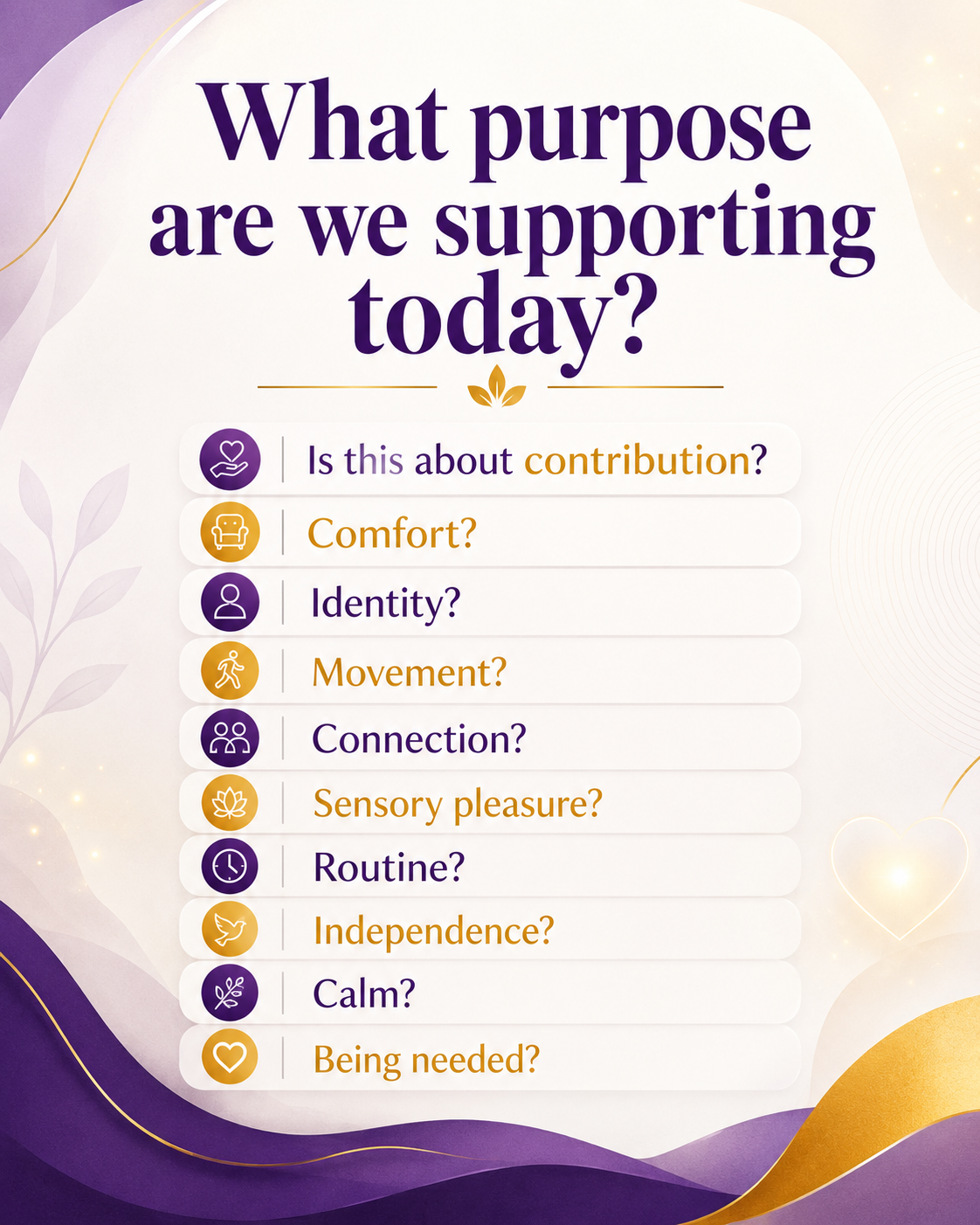
Once we know the purpose, the activity becomes easier to shape.
A person who needs contribution may enjoy setting tables more than attending trivia.
A person who needs calm may do better with sorting fabric than joining a loud group.
Perhaps someone who loved cooking may enjoy washing vegetables, stirring batter, folding tea towels, or arranging recipe cards…and someone who worked in an office may enjoy sorting envelopes, organizing folders, stamping papers, or matching labels.
And a very tidy person may enjoy arranging drawers, folding cloths, pairing socks, or straightening magazines.
The activity should fit the person, not just the calendar.
Slow and steady is not passive
There is a misunderstanding that “slow” means nothing is happening. But in dementia care, slow can be very active.
Slow means :
- noticing
- getting up
- waiting
- observing what the person can still do
- offering the next cue at the right time
- resisting the urge to take over
- allowing the person to experience success
That kind of slow requires skill. It is often harder than rushing.
Rushing lets us control the task. Slowing down allows the person to participate.
The real win
When purposeful activity is done well, the “win” is not a finished craft, a completed worksheet, or a full activity room.
The win is the person who feels useful again. And the one who stayed calm because the task made sense.
And the caregiver who did not have to push, persuade, or redirect over and over.
The win is the family member who sees their loved one still participating in familiar life and the team learning that meaningful engagement does not always require more programs. Sometimes it requires better pacing, better set-up, and a better understanding of the person.
Slow and steady wins the race because dementia care is not a sprint from one activity to the next.
It is the steady work of preserving dignity, ability, identity, and connection.
And that cannot be rushed.