
Motor Exercise vs. Functional Role in Montessori Dementia Care – If you spend time in any memory care community, you will inevitably see it: a basket of towels placed in front of a resident, who contentedly folds them one by one. This is all about the two tracks for towel folding…
For years, folding laundry has been the quintessential “go-to” activity in dementia care. It is comforting, it leverages intact procedural memory, and it keeps a resident occupied.

Track 1: The Repetitive Motor & Sensory Exercise
The first reason caregivers turn to towel folding has nothing to do with laundry; it is about preserving abilities, tactile sensory regulation, or calming anxiety.
When a person needs an activity that satisfies a desire to move their hands and anchors their attention in a failure-free task, folding is excellent. But we must stop pretending it is a “laundry crisis.” Instead, we should treat it exactly like an independent learning design, sorting task, or cognitive exercise.
- The Presentation: The materials are clearly organized on a dedicated workspace or shelf. The caregiver invites the resident to engage with the material directly: “Mrs. Marone, I have these fabrics here to practice coordination and folding today. Would you like to try it?”
- The Completion: Because this is recognized and presented as an exercise, there is no need for trickery when it is finished. Just as a child in a traditional Montessori classroom rolls up a work mat and resets the blocks when done, the resident can help reset the basket for its next use. No illusions required.
Track 2: The Functional Role (Community Contribution)
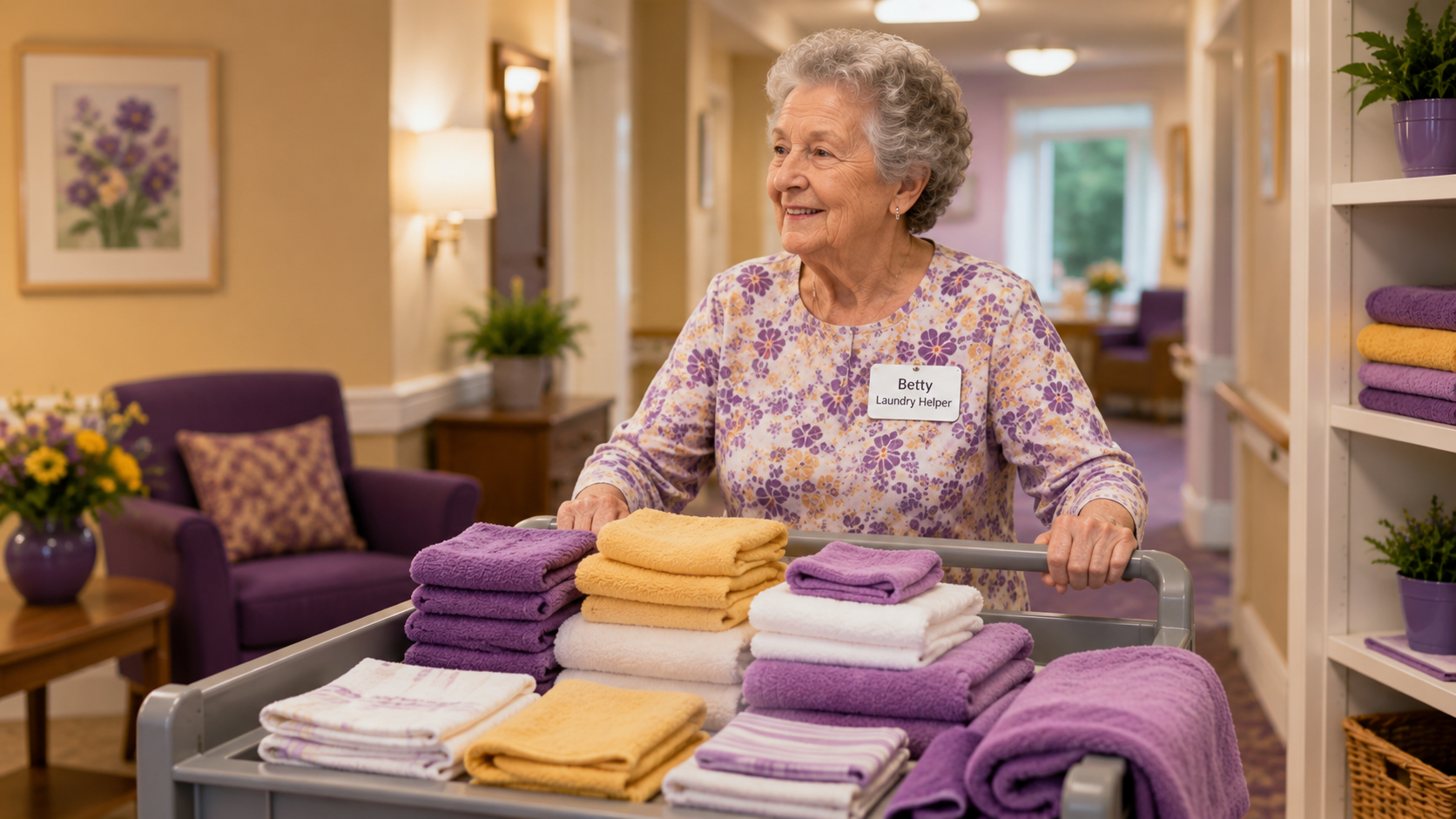
The second reason we value folding is for identity, adult dignity, and community belonging.
In a Montessori framework, an activity is meaningful if it has a real-world purpose and a visible contribution to the community or home. If a resident valued order or homemaking in their past, they can be invited to join a formal Hospitality Committee or Environmental Care Team. Here, towel folding is a designated, respected daily contribution.
- The Presentation: The request must be 100% genuine. The community must actually need the towels for an operational purpose. A caregiver might say: “Mrs. Marone, the spa team just sent up these towels and we need them ready for the afternoon baths. Could you help us prepare them?”
- The Completion: You do not unfold them. The towels are taken directly to the linen closet, the spa room, or the dining room to be used.
- The Montessori Reality: If there are no real towels that actually need folding that day, then the resident does not fold towels that day. Instead, their functional role might involve a different genuine task, like setting tables, wiping down surfaces, or organizing a common area.
Moving Beyond the Confusion
The confusion in memory care happens when caregivers try to dress up a motor exercise (Track 1) in the clothes of a functional role (Track 2) because they assume an adult won’t do an exercise without a fake chore attached to it.
By separating the two, you give your team absolute clarity. When designing an intervention, staff must ask themselves one simple question:
Are we trying to provide a sensory motor exercise, or are we assigning a functional community role?
Once you name the true intent, you eliminate the busy work, eliminate the trickery, and protect the resident’s dignity.