

In long-term care, the phrase “responsive behavior” is everywhere. It appears in documentation, care plans, shift reports, and team discussions. It has helped move the sector away from blaming language like “aggressive” or “difficult,” and toward a more person-centered understanding.
But there’s a deeper issue we need to confront: By the time something is labeled a responsive behavior, we are already late.
“Responsive Behavior” Is a Late-Stage Indicator
Why our language—and our timing—may be failing the people we care for.
The Problem Isn’t the Behavior—It’s the Timing
When a resident strikes out, refuses care, calls out repeatedly, or becomes visibly distressed, we identify it as a responsive behavior and mobilize a response. We analyze triggers, adjust approaches, and document interventions.
But these moments are not the beginning of the story.
They are the escalation.
A “behavior” is often the final, visible expression of a series of unmet needs, misinterpretations, or environmental mismatches that started much earlier—quietly, subtly, and often unnoticed.
In other words:
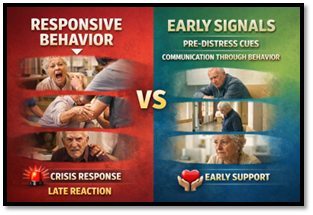
The behavior is not the first signal. It is the last.
 The Signals We’re Missing
Long before a resident resists care or raises their voice, their body is already communicating.
Experienced caregivers often recognize these early cues instinctively—but our systems don’t always support acting on them.
Look closely, and you’ll see:
- A slight tightening of the jaw
- A shift in posture—leaning away, pulling back
- Repetitive pacing or restless movement
- Withdrawal from usual engagement
- Changes in facial expression—tension, worry, confusion
- A pause that lasts just a bit too long
These are not random. They are communication.
They are the resident telling us: “Something is not right.”
But because these signals are subtle, fleeting, and harder to document, they are often overlooked in favor of more obvious, reportable events.
A System That Trains Us to Respond Late
Healthcare professionals in LTC are not inattentive. Far from it. They are highly observant, skilled, and deeply committed.
However, the systems we work within tend to reinforce late response:
- Documentation frameworks prioritize observable “incidents” over subtle changes
- Staffing models emphasize task completion over relational pacing
- Training often focuses on managing behaviors once they occur
- Language itself anchors attention to the moment of escalation
We are, in many ways, conditioned to act when something becomes a problem—rather than when it first begins to shift.
This creates a reactive cycle:
- Subtle cue appears
- Cue is missed or deprioritized
- Distress builds
- Behavior emerges
- Intervention begins
And then we call that care.
What If We Redefined the Starting Point?
What if we stopped treating “responsive behavior” as the moment to begin?
What if we saw it instead as evidence that we missed earlier opportunities?
This is not about blame. It’s about recalibration.
When we shift our focus upstream, several things change:
- Care becomes preventive rather than reactive
- Interactions become more attuned and less task-driven
- Escalations decrease—not because we manage them better, but because we intercept them earlier
- Residents experience less distress, not just better responses to distress
This requires a different kind of attention—one that values the small, the subtle, and the easily dismissed.
From Managing Behaviors to Reading People
If we accept that behaviors are late-stage indicators, then our role shifts.
We are no longer primarily behavior managers (and Montessori teaches us NOT to be.)
We become observers of human signals.
This means asking different questions:
- What changed just before this moment?
- What is this person communicating through their body right now?
- What does this environment demand of them—and can they meet that demand?
- Where is the mismatch?
It also means slowing down—not in terms of efficiency, but in terms of perception.
Because early signals don’t announce themselves.
They require us to notice.
 The Opportunity for Experienced Teams
This perspective often resonates most strongly with experienced healthcare professionals—because many have felt this truth long before it was articulated.
You’ve seen the resident who becomes “agitated” during care—but only after subtle signs of discomfort were missed.
You’ve noticed how one small adjustment—a different tone, a pause, a repositioning—can prevent an escalation entirely.
You already know, at some level, that the behavior is not the beginning.
The opportunity now is to make that implicit knowledge explicit—and to build systems, language, and team practices that support earlier recognition.
A Language Shift That Changes Practice
Language shapes attention.
When we say “responsive behavior,” we anchor ourselves to the outcome.
When we begin to speak about early signals, pre-distress cues, or communication through behavior, we shift our point of entry.
This is more than semantics. It changes when—and how—we act.
Click for details and registration information for our 1-Day Dementia Care Training for PSWs – Montessori Dementia Center