

We talk about residents having nervous systems. We talk about dysregulation. Agitation. Escalation. Calm. But we rarely talk about something just as influential: The nervous system of the unit itself.
Because every care environment has one. You can feel it within seconds of walking in.
You Don’t See It — But You Feel It
Is the hallway tight and tense? Are voices clipped and fast? Are call bells constant? Is everyone reacting?
Or is there a steady rhythm?
Measured pace. Lowered voices. People anticipating rather than scrambling.
Units develop patterns. And patterns become physiology.
Regulation Is Contagious
The nervous system does not operate in isolation. Humans co-regulate.
When one person is tense, others subtly mirror it. But if one person is calm and steady, others often settle.
Now multiply that by 25 residents and 10 staff.
If the dominant tone of the unit is urgency, unpredictability, and correction, everyone’s stress baseline rises — residents and staff alike.
If the dominant tone is predictable, respectful, and paced, the opposite happens.
The body softens. Even in dementia. Especially in dementia.
What Dysregulation Looks Like at the Unit Level
It doesn’t always look dramatic. Sometimes it looks like:
- Constant redirection
- Frequent reminders and corrections
- Loud cueing across rooms
- Rushing from task to task
- Residents waiting with nothing to anchor them
Nothing here sounds extreme. But over time, it creates a background hum of activation.
And when the background hum is loud enough, small things tip people over.
What Regulation Looks Like at the Unit Level
It looks quieter. Not silent — but steady. Staff approach rather than call out.
Transitions are predictable. Morning routines follow similar patterns daily.
Residents are engaged in contribution, not just waiting.
Staff still work hard. But the energy is directed rather than scattered.
Problems are prevented earlier and friction is reduced before it becomes behavior.
The difference isn’t accidental. It’s engineered.
Leadership’s Hidden Influence
Leadership sets the tone more than policies ever will.
If urgency is rewarded, urgency will spread. When speed is praised above alignment, speed will dominate.
If prevention is valued — and staff are taught how to do it — the unit’s physiology shifts.
Burnout drops. Escalations decrease. Call bells change frequency. Because the environment itself becomes stabilizing.
 A Quiet Question
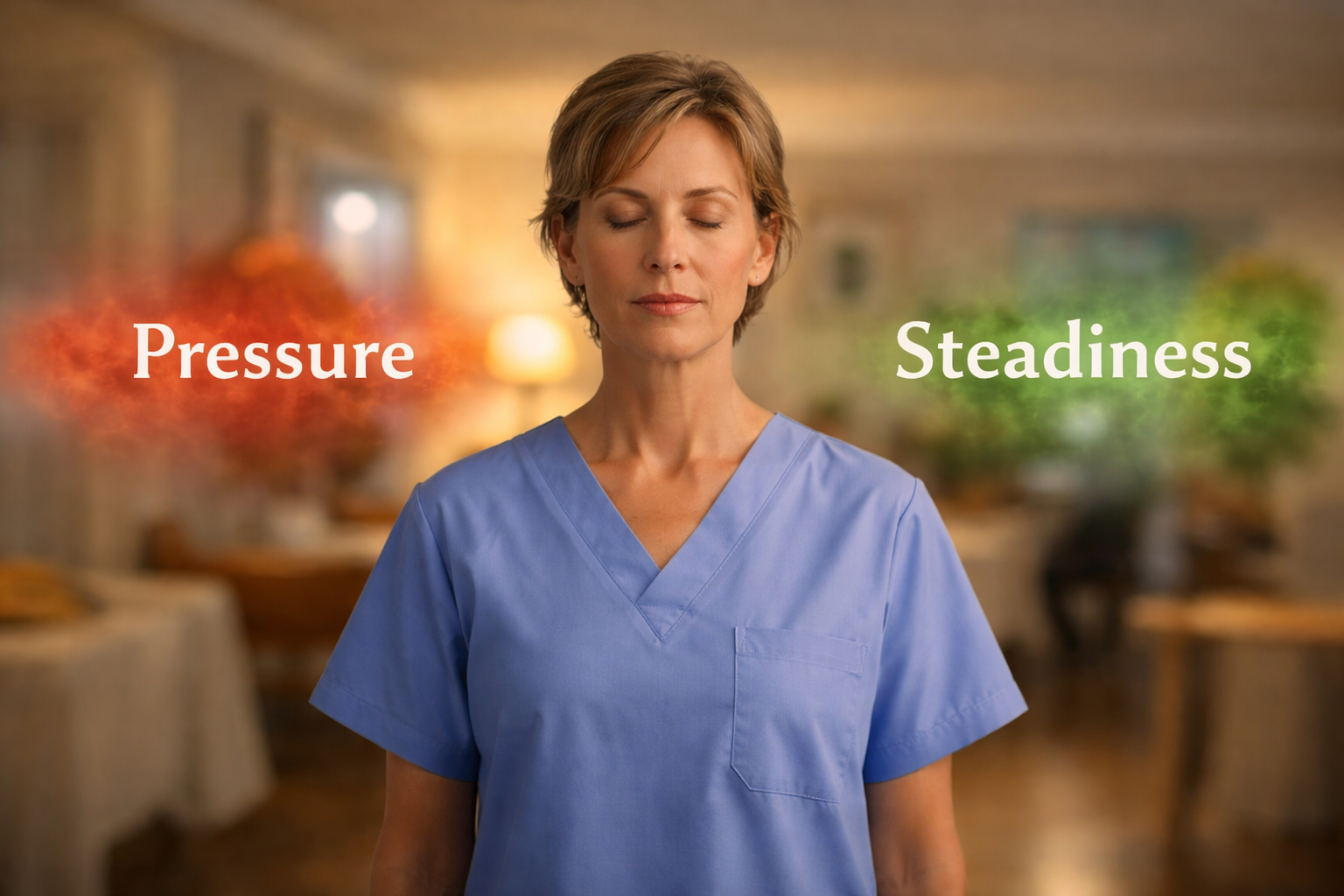
If someone walked into your unit for the first time and closed their eyes, what would they feel?
Pressure? Or steadiness?
The nervous system of the unit is always communicating.
The question is: What is it saying?