When Memory Fails, What Replaces It?
When people think about dementia, they often think first about memory loss. That is understandable. Memory changes are among the most visible and recognizable signs of dementia. A person may forget names, dates, instructions, appointments, conversations, or what just happened a few moments ago.
But there is a dangerous assumption hidden inside the phrase “memory loss.”
It can sound as if something disappears and nothing takes its place.
That is not true.
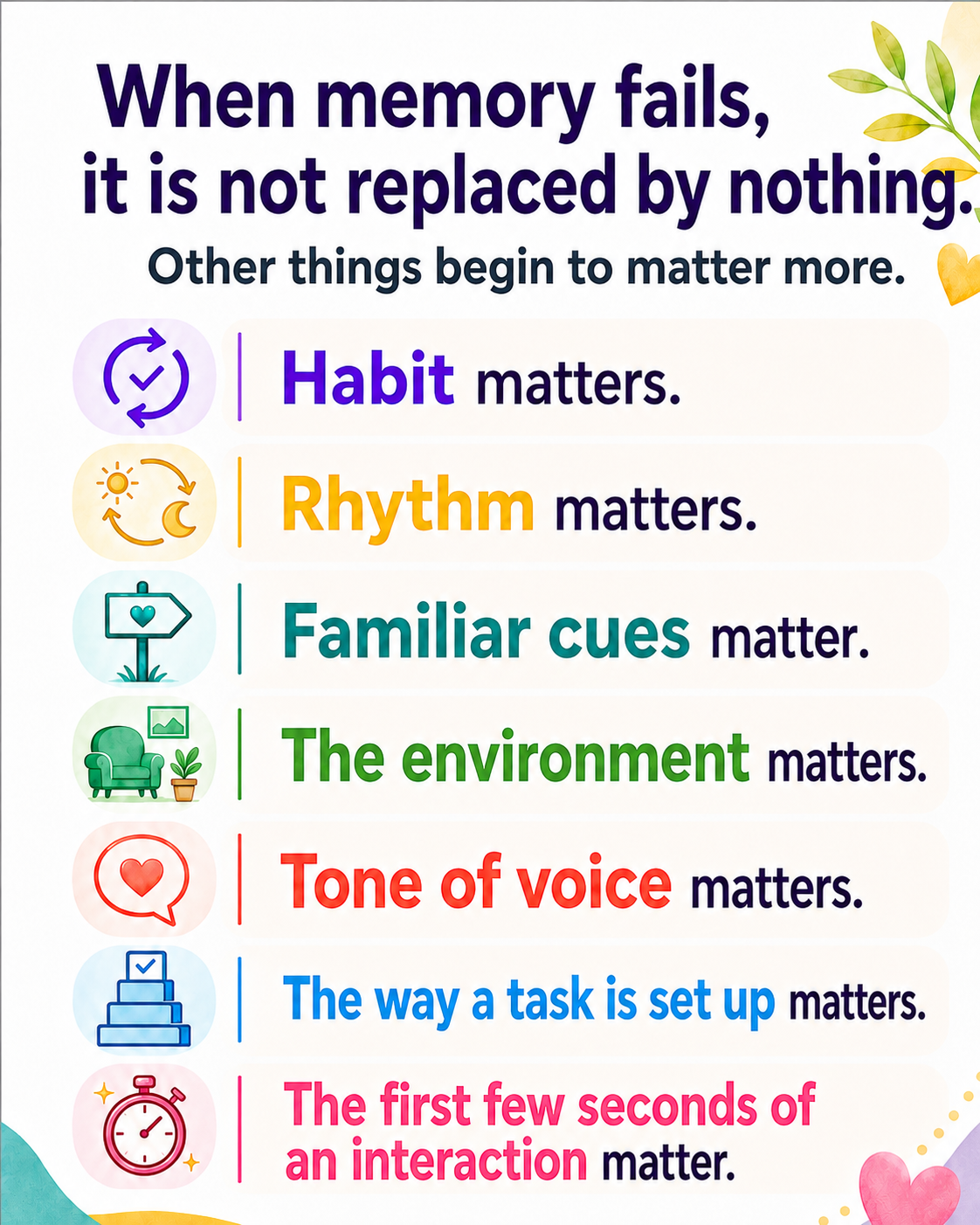
When memory fails, it is not replaced by nothing. Other systems, supports, and signals begin to carry more of the load. Habits, cues, rhythm, environment, emotional tone, familiar objects, and repeated patterns can all help a person understand what is happening and what to do next.
This idea is central to Montessori principles in dementia care.
The goal is not to keep testing memory. The goal is to support the person by using what still works.
Memory Is Not the Only Guide
Most of us rely on memory all day without noticing it.
We remember where the bathroom is and what time lunch usually happens and how to brush our teeth, make coffee, set the table, open a drawer, or greet a familiar person.
We remember the steps in a routine without anyone explaining them each time.
When dementia affects memory, those everyday tasks can become harder. But that does not mean the person has no way to participate, respond, or succeed.
Other forms of support can step in.
A familiar towel may cue washing.
A place setting may cue mealtime.
A basket of napkins may cue folding.
A name tag may cue recognition.
A sign may cue direction.
A calm voice may cue safety.
A repeated routine may cue what comes next.
The person may not be able to recall the instruction, but they may still respond to the cue.
That difference matters.
Habits Can Remain Powerful
Habits are deeply learned patterns. They are often built over many years through repetition. Even when short-term memory becomes unreliable, familiar actions may still be accessible.
This is why a resident who cannot remember what they had for breakfast may still know how to wipe a table, fold towels, polish silverware, sort objects, water plants, or greet guests.
They may not remember the purpose of the activity in a verbal way, but the body and mind may still recognize the pattern.
This is one reason meaningful roles are so important. A person who spent years caring for a home, raising children, organizing papers, working with tools, preparing meals, managing a desk, or helping others may still respond to opportunities that feel familiar and purposeful.
The task does not need to be childish or artificial. It needs to be recognizable, respectful, and set up for success.
Cues Help Replace Repeated Verbal Reminders
In many care settings, staff rely heavily on verbal instruction.
“Come this way.”
“Sit here.”
“It’s time to eat.”
“Put your arm in the sleeve.”
“Don’t go there.”
“You already asked me that.”
But when memory and processing are affected, more words do not always help. In fact, too many words can increase confusion.
Cues are different.
A cue gives the person something to see, touch, recognize, or follow. It reduces the need to hold instructions in memory.
For example, a caregiver might place the toothbrush in the resident’s hand instead of explaining every step. A sign on a door may help someone find the bathroom without asking. A clothing item laid out in sequence may help the person begin dressing. A basket of folded and unfolded towels may invite participation without a long explanation.
This is not about decorating the environment. It is about making the environment communicate.
Rhythm Creates Safety
People with dementia often do better when the day has a familiar rhythm. Not a rigid schedule forced on everyone, but a predictable pattern that helps the person feel oriented.
Rhythm answers questions the person may no longer be able to ask clearly:
What happens now?
Where am I supposed to be?
What is expected of me?
Is this safe?
Do I belong here?
A predictable rhythm can reduce uncertainty. It gives the person repeated opportunities to recognize the flow of the day.
This is why consistency matters. The same approach, the same setup, the same visual cues, the same sequence, and the same respectful language can help the person participate with more confidence.
When the rhythm keeps changing, the person has to keep figuring out the world all over again.
That is exhausting.
The Environment Starts Doing Some of the Work
In Montessori, the prepared environment is essential. The environment is not passive. It teaches, supports, invites, and guides.
In dementia care, this is especially important.
A well-prepared environment can reduce the demand on memory; make the next step more obvious; help the person find what they need; invite useful activity and reduce unnecessary confusion.
A cluttered environment asks the person to sort through too much information. A clear environment helps the person focus.
A hidden item requires memory. A visible item provides a cue.
A blank hallway may create uncertainty. A meaningful sign or familiar landmark may support direction.
A staff member without a name tag requires recall. A clear name tag provides immediate support.
These small details are not small to the person living with dementia. They can be the difference between dependence and participation, between hesitation and action, between distress and calm.
Emotional Tone Often Replaces Explanation
When memory fails, people may not remember the details of what was said. But they may still respond strongly to how a moment feels.
They may read facial expression, tone of voice, body position, pace, and emotional energy. They may not understand every word, but they can often sense whether they are being rushed, corrected, pressured, dismissed, or respected.
This is why the first few seconds of an interaction matter so much.
Before the caregiver gives an instruction, the resident may already be reading the situation:
Is this person safe?
Are they rushing me?
Am I in trouble?
Do I have any control?
Can I trust what is happening?
A calm approach can become a cue. A rushed approach can become a trigger.
This is not about being fake or overly cheerful. It is about understanding that emotional tone becomes part of the support system.
The Montessori Question: What Still Works?
Traditional care can sometimes focus too heavily on what the person has lost.
Montessori-informed care asks a different question:
- What abilities remain?
- What habits are still familiar?
- What cues does the person respond to?
- What roles still feel meaningful?
- What environment helps them succeed?
- What rhythm makes the day easier?
- What can we change around the person instead of trying to force the person to change?
This is a more hopeful and more practical way to support dementia care.
It does not deny the reality of memory loss, but simply refuses to treat memory loss as the end of the story.
It Is Not Nothing
When memory fails, the person still responds.
They respond to kindness.
>They respond to tone.
>They respond to familiarity.
>They respond to rhythm.
>They respond to visual cues.
>They respond to meaningful objects.
>They respond to purpose.
>They respond to environments that make sense.
>They respond to people who know how to support them without overwhelming them.
That is why Montessori principles align so beautifully with dementia care. They help us stop asking memory to do all the work.
Instead, we build support around the person. We:
⇒use cues
⇒create rhythm
⇒prepare the environment
⇒preserve roles
⇒offer choice
⇒make success more visible and more possible
When memory fails, it is not replaced by nothing.
With the right approach, it can be supported by everything around the person.