
What are the three quiet threats to life with dementia? Loneliness, Boredom and Helplessness. There are many things we watch carefully in dementia care. Falls. Weight loss. Pain. Medication. Sleep. Skin integrity. Mobility. Responsive behaviours…and more.
But some of the most important influences on a person’s day are much harder to see.
A person does not have to be physically alone to feel lonely. They do not have to be sitting with absolutely nothing to do to feel bored. And they do not have to be completely dependent to feel helpless.
That distinction matters.
Because sometimes we look at the circumstances surrounding a person and conclude that the problem could not possibly exist.
- “She’s never alone.”
- “There are activities all day.”
- “Staff do everything for him.”
And yet the person may still experience profound loneliness, boredom or helplessness.
In dementia care, we have to be interested not only in what is happening around the person, but in what life may feel like to the person.

Loneliness Is Not the Same as Being Alone
We often think of loneliness as a shortage of people.
Put someone in a room with other residents, invite them to group programs, have staff coming and going throughout the day, and loneliness should disappear. Except it doesn’t always work that way. Someone can be surrounded by people and still feel profoundly alone.
Think about what connection actually requires.
It requires being noticed. Being understood. Being known. Having someone respond to you as a person rather than simply as someone who needs care.
A resident may spend breakfast with thirty other people, attend an exercise group, sit in the lounge throughout the afternoon and receive several visits from staff.
Technically, that resident has been around people all day.
But how many genuine moments of connection occurred?
- Did anyone sit beside her and talk about something that matters to her?
- Did anyone ask for her opinion?
- Did somebody laugh with her?
- Was she included in what was happening around her?
- Did anyone recognize something she was trying to communicate?
- Did she feel that somebody knew who she was?
That is a very different question.
Dementia can make loneliness even more complicated because the person’s ability to initiate and maintain relationships may change.
They may no longer remember someone’s name. They may lose the thread of a conversation. They may have difficulty finding the words they want. They may withdraw because conversations move too quickly.
They may not recognize that the person sitting beside them is someone they have known for years.
And sometimes they may simply stop initiating contact. That does not necessarily mean they no longer need connection. It may mean we have to become better at creating the conditions for connection.
There is another kind of loneliness that deserves attention too:
the loneliness of losing one’s place in the world.
A person may once have been a parent everyone called for advice, the person who organized every family dinner, the neighbour who knew everyone on the street, the manager who ran a department, the volunteer who never missed a meeting.
Now people may make decisions around them. They may be talked about rather than talked with. Others may know the schedule, the plan and what happens next while the person simply follows.
That can create a different kind of isolation.
Not necessarily, “There is nobody here.” But perhaps: “I am no longer part of what is happening.”
That may be one of the most important forms of loneliness for us to notice.

Boredom Can Exist in a Very Busy Day
Now consider boredom.
Many residences have extremely full activity calendars.
Breakfast. Exercise. Music. Snack. Craft. Lunch. Bingo. Walk. Afternoon program. Dinner. Television. Evening activity.
There is certainly no shortage of scheduled events.
But a full calendar and a meaningful day are not necessarily the same thing.
Boredom isn’t simply the absence of stimulation.
It can also be the absence of meaning.
Imagine being taken to one activity after another when none of them particularly interests you.
Imagine repeatedly being asked to colour, play a game or watch entertainment that has little connection with the person you have been throughout your life.
You may be occupied.
You may even be busy.
But you can still be bored.
There is also a difference between being entertained and being engaged.
Entertainment is something happening in front of us.
Engagement means we have some part in what is happening.
That part does not have to be large.
A person may be unable to prepare an entire meal but still stir ingredients.
They may not be able to arrange an entire seasonal display but may choose between two colours.
They may not be able to run a meeting but may still contribute an opinion.
They may not be able to complete a complicated craft but may sort materials, hold something, fold something, place something or make one decision.
The important question becomes:
What part of this can the person still do?
That is very different from deciding that because the whole task is too difficult, there is nothing left for them to do.
And boredom does not occur only during the periods we formally call “activity time.”
Much of life happens between activities.
- Waiting for lunch.
- Sitting while someone finishes care.
- Walking from one room to another.
- Watching staff prepare something.
- Sitting near the nurses’ station.
- Waiting for transportation.
- Waiting for someone to tell you what happens next.
Those minutes add up to hours.
A Montessori-inspired approach asks us to look at those moments differently.
Instead of seeing them as empty time that must be filled with another scheduled program, we can ask:
What opportunity exists here?
- Could the person help carry something?
- Fold napkins?
- Water a plant?
- Choose music?
- Arrange flowers?
- Sort mail?
- Wipe a table?
- Talk with someone?
- Put menus out?
- Help prepare for the next program?
- Welcome another resident?
The goal is not to keep people continuously busy. People need rest, quiet, solitude and time to themselves.
The goal is to make sure that when a person wants to participate in life, there is something meaningful available to participate in.

Helplessness May Be Created With the Best Intentions
Perhaps the most uncomfortable of the three is helplessness.
Because sometimes care itself can accidentally contribute to it. Good caregivers are helpers. They see something that needs doing and they do it.
A resident struggles with a sleeve, so we put the arm through. Someone is taking too long with breakfast, so we feed them. A person cannot complete a task properly, so we finish it. Someone is having difficulty folding a towel, so we take over.
It is efficient. It may even feel kind. But there is a fine line between helping a person succeed and removing the person’s opportunity to participate.
When we repeatedly do everything for someone, a message can slowly emerge:
- “You cannot do this.”
- “I’ll do it.”
- “It’s easier if I take over.”
- “You don’t need to try.”
Nobody has to say those words.
The experience can communicate them.
Eventually the person may stop trying.
And then we may interpret the lack of initiative as further evidence of decline.
That is where the Montessori principle of maximum ability, minimum assistance becomes so powerful.
The question is not:
“Can this person do the entire task independently?”
The better question is:
“What is the least amount of help this person needs to participate successfully?”
- Perhaps the resident cannot put on a sweater independently. But can they place one arm into the sleeve?
- Perhaps they cannot prepare breakfast. But can they butter their own toast?
- Perhaps they cannot make a full cup of tea. But can they choose tea or coffee?
- Perhaps they cannot organize their room. But can they decide where something belongs?
Small acts of participation may seem insignificant when we are focused on completing tasks.
They are not insignificant to the person. They reinforce ability. Choice. Identity. Competence. Control. And being needed.
Helplessness Is Also About Decision-Making
Helplessness is not only physical. It can come from having very few decisions left to make.
- When to get up.
- What to wear.
- Where to sit.
- What to eat.
- When to bathe.
- Whether to participate.
- Who to spend time with.
- What to do next.
In institutional care, decisions can easily migrate away from the resident because schedules are complicated and staff need to get things done. But when almost every part of the day is decided by somebody else, a person may begin to experience life as something that simply happens to them.
This is where supported choice becomes important.
Choice does not mean asking a broad question that overwhelms someone:
“What would you like to do today?”
For a person who can no longer easily generate options, that may not feel empowering at all.
Supported choice might be:
- “Would you like the blue sweater or the green one?”
- “Would you like to sit by the window or near the fireplace?”
- “Would you like tea or coffee?”
- “Would you like to help with the flowers or the napkins?”
The person is still making the decision. We have simply changed the way the choice is presented so they can use the abilities they still have.
What If the Person Only Feels Lonely, Bored or Helpless?
This may be the most important point.
Suppose staff say:
“But she isn’t lonely. Her daughter visits every day.”
Or: “He can’t be bored. He goes to three programs.”
Or: “She’s not helpless. We take excellent care of her.”
Those statements may all be factually true. And still miss the point. Because human experience is not determined only by objective circumstances.
A person can have visitors and feel lonely. They can participate in programs and feel bored. They can receive excellent physical care and still feel powerless.
The feeling matters because the person’s experience is real to them.
We do not need to prove whether someone is “actually” lonely before trying to create connection.
We do not need to prove that someone is “really” bored before looking for more meaningful engagement.
And we do not need to establish that someone is objectively helpless before finding more opportunities for choice and contribution.
Instead, we can become curious. What is this person’s day telling us? Are they repeatedly seeking staff? Calling out?
Following people? Sleeping through much of the day? Declining activities? Pacing? Repeatedly asking what they should do? Becoming restless at predictable times? Watching others work? Trying to help? Interfering with tasks?
Those actions may have many explanations.
But rather than immediately asking, “How do we stop this?”, they give us an opportunity to ask:
“What might be missing?”
The Three Problems Often Feed Each Other
One well-designed opportunity can address all three at once.
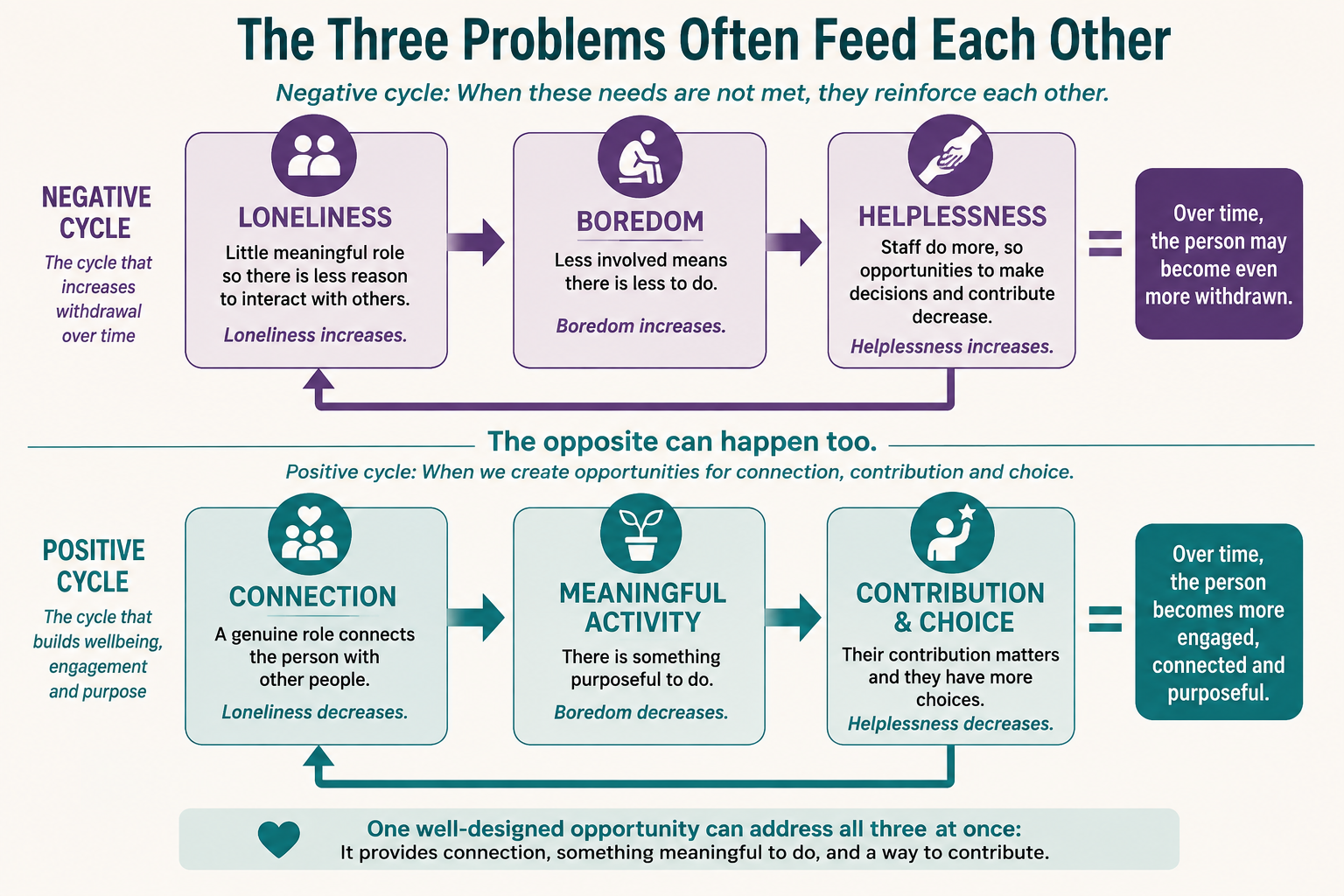
A resident committee is a good example.
A resident who belongs to a Decor Committee is not merely attending another activity. They belong to something.
The same people meet regularly. There is a purpose. There is work to do.
One person may choose colours. Another may sort decorations. Another may arrange flowers. Another may decide where something should be placed.
Someone with more advanced dementia may complete one small, meaningful part of the task.
The committee creates connection, occupation and contribution at the same time. That is very different from simply adding another hour to the activity calendar.
The Solution Is Not “More Activities”
This is where organizations can easily go wrong.
When we identify boredom or loneliness, the instinct can be to add more programming.
Another game. Another entertainer. Another craft. Another scheduled group.
Those things can certainly have value. But the deeper solution is not necessarily more activity.
It is more meaningful life.
- That means knowing people well enough to understand what matters to them.
- It means noticing remaining abilities instead of only losses.
- It means creating environments where useful things are visible and accessible.
- It means giving people legitimate roles.
- It means building connection into ordinary moments.
And it means resisting the urge to automatically do everything for somebody simply because we can do it faster.
What Can We Actually Do?
The solutions do not have to be dramatic. In fact, many of the most powerful changes are small enough to happen during the normal rhythm of the day.
- Look for connection, not simply proximity. Ask whether the person has genuine moments of being noticed, known, heard and included.
- Learn the person’s history. Past roles, interests, routines and preferences give us clues about what may still feel meaningful.
- Create meaningful roles. Give residents real ways to contribute to the life of the home—committees, welcoming, decorating, gardening, setting tables, preparing materials, helping with events or other responsibilities suited to their abilities.
- Use the smallest meaningful step. When the whole task is too difficult, reduce the step rather than removing the activity.
- Practise maximum ability, minimum assistance. Before taking over, ask what part the person can still do and what is the least help required for success.
- Offer supported choices throughout the day. Small decisions restore control.
- Make purposeful materials visible and accessible. Engagement is more likely when the environment invites participation rather than requiring staff to initiate everything.
- Look beyond the activity calendar. Identify opportunities for connection, contribution and participation during ordinary moments between formal programs.
- Watch for patterns. Repeated calling out, following staff, restlessness, withdrawal or refusal may be information. Ask what might be missing before deciding what the behaviour means.
- Create continuity. Familiar people, regular committees, predictable routines and recurring roles can develop belonging.
- Measure meaningful moments, not simply attendance. Being present at an activity is not the same as being engaged by it.
- Ask one question repeatedly: What opportunity does this person have today to connect, contribute, choose or use
- an ability they still have?
We may never know with certainty whether a person living with dementia is lonely. We may not always be able to ask them whether they are bored and receive a clear answer. And they may never say:
“I feel helpless because everybody decides everything for me.”
But we do not need to wait for those words. We can look at the life we have helped create around the person.
- Does this person have somebody to connect with?
- Do they have something that matters to do?
- Do they have opportunities to make decisions?
- Does anyone need their contribution?
- Are we supporting the abilities that remain?
- Do they belong to something?
And perhaps most importantly:
Is the person simply being cared for — or are they still participating in their own life?
That may be one of the most useful questions we can ask in dementia care.