
There are so many opportunities for resident choice. It goes way beyond “the red shirt or the blue one?” Choice is not just “Which one do you want?” It is also “How would you like this to happen?”
When we talk about choice in dementia care, the examples are often very small, like “Would you like the red shirt or the blue one?” or “fish or chicken?” or “coffee or tea?”
These are useful choices, for sure. They can help a person maintain involvement in everyday decisions, particularly when too many options would be confusing. But if this is where our understanding of resident choice ends, we are setting the bar far too low.
Choice is not simply a technique we use during dressing or at mealtimes. It is part of autonomy, identity and dignity. It is about having some influence over how your own life unfolds.
For someone living in a long-term care or retirement residence, that matters enormously.
Choice Is Bigger Than Choosing Between Two Things
Imagine moving into a residence where much of your day has already been decided.
Someone determines when breakfast is served. Someone decides when you will be helped to get dressed. Activities appear on a calendar. Furniture is arranged for you. People enter your room. Appointments are scheduled. Meals arrive. Staff have routines to follow.
None of this is necessarily done with bad intentions. Much of it is necessary to operate a residence safely and effectively.
But gradually, a person can move from living their life to having their life organized around them.
Offering two shirts does not completely solve that.
Real choice asks a broader question:
Where can this person still have genuine influence over what happens in their own day?
Start With the Person’s Existing Life
Choice becomes much more meaningful when we know the person.
A resident who spent 40 years getting up at 5:30 every morning may not suddenly want to sleep until 9:00 because that works better with the residence routine.
Someone who always showered at night may not understand why bathing is now happening Tuesday morning.
A person who never enjoyed large social gatherings may not suddenly want to attend every group activity simply because activities are considered “good for them.”
The more we know about a person’s routines, preferences, habits and personality, the easier it becomes to preserve choice in ways that actually matter.
The question is not merely:
“What would you like?”
It is also:
“What has always mattered to you?”
Choice Can Be About How Something Happens
Sometimes the decision itself cannot be avoided. A person may need assistance with personal care, medication, meals or safety.
But there may still be considerable choice around how it happens.
Perhaps the person chooses who assists them when staffing permits. Perhaps they prefer washing before breakfast rather than afterward. Maybe they want to wash their own face while staff help with something else. They might prefer the bedroom door closed, a particular towel, music playing, or a few minutes to wake up before anyone begins helping.
The care requirement may remain the same.
The experience of receiving that care can be very different.
This is where choice and retained ability often come together.
Instead of asking, “What can we do for this person?”, we can ask:
“What parts can they still decide, initiate or do themselves?”
Sometimes Choice Means Saying No
This can be one of the more difficult parts of respecting choice.
We tend to appreciate choice when the person chooses what we hoped they would choose.
“Would you like to attend music?”
“Yes.”
Wonderful.
But what if the answer is no?
What if the resident does not want the activity, does not want the sweater we selected, does not want to sit where we suggested, or does not want to begin something at the moment we planned?
A choice is not very meaningful if only one answer is acceptable.
Of course, dementia care includes legitimate questions of health, safety and capacity. Not every request can always be accommodated. But we should be careful not to turn staff convenience, routine or preference into a safety issue when it is not one.
Sometimes the most respectful response is simply:
“All right. We can try again later.”
Choice Is Also About Participation
Residents should not only be choosing between things staff have already decided.
They can also help shape life in the residence.
- Which flowers should go on the dining tables?
- What should be planted in the garden?
- What music would they like at an event?
- Should the resident committee raise a particular concern?
- Which decorations should be used?
- Would they like to help welcome a new resident?
- Could they help decide how a shared space is arranged?
These choices are different from choosing tea or coffee because they allow the person to contribute and influence, not merely receive.
That distinction matters.
Choice can create belonging.
Dementia Changes How We Offer Choice
Respecting choice does not mean presenting someone with endless possibilities.
“What would you like to wear today?” may be difficult for someone who cannot visualize the contents of a closed wardrobe.
Putting two appropriate outfits where the person can see them may allow that same person to make the decision successfully.
Similarly, asking, “What would you like to do today?” may be too abstract.
Showing someone two familiar possibilities may make the choice understandable.
This is not reducing autonomy. It is supporting the person so they can still exercise it.
Good choices are understandable, manageable and genuine.
We Also Need to Notice Choice Without Words
Not every resident will be able to tell us clearly what they want. Choice may appear in a gesture.
A person reaches toward one sweater and pushes another away. They move toward a particular chair.
Sometimes they smile when a particular song begins. Maybe they turn their head away from something they do not want. Maybe they linger near the garden. Or repeatedly pick up the same type of object. These behaviours give us information.
If we are paying attention, residents may be making choices all day long.
Our job is not simply to ask questions. It is also to notice the answers they are already giving us.
The Bigger Question
“The red shirt or the blue one?” is still a perfectly good question. So is “fish or chicken?” We should keep offering those choices. But we should not mistake them for the full meaning of autonomy.
Resident choice also means having influence over routines, surroundings, relationships, participation, privacy, pace, meaningful roles and the way support is provided.
Perhaps the question we should regularly ask ourselves is:
“Where in this person’s daily life can we create more opportunity for genuine choice?”
Then look around the residence. There may be far more opportunities for choice than we realize.
In fact, opportunities are almost everywhere—if we stop thinking of choice only as choosing between two items.
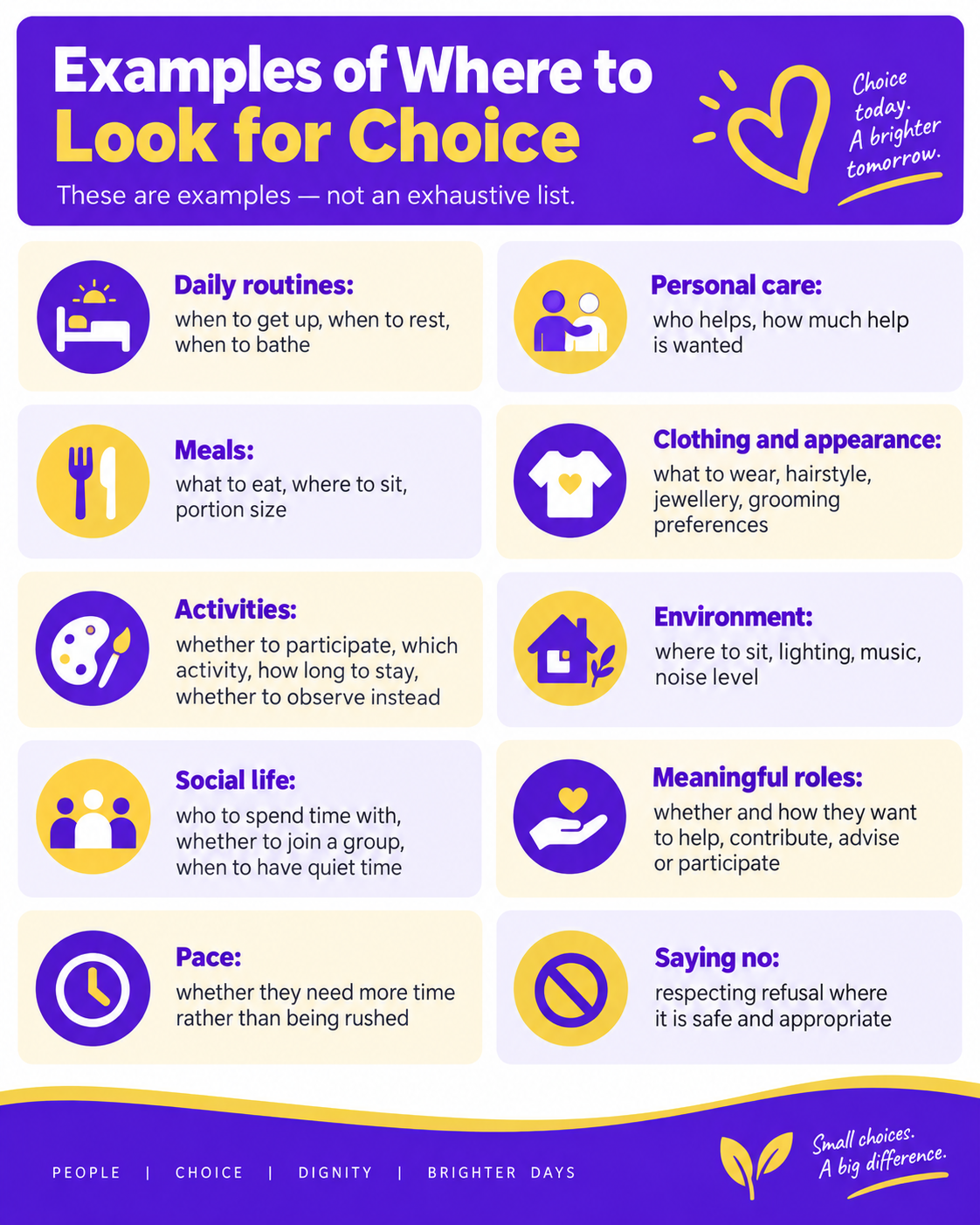
The simplest message for staff might be:
Remember, choice is not just “Which one do you want?” It is also “How would you like this to happen?”
Join us for an online, live and interactive session of Resident Choice: Part One and Part Two… check them out here:
Resident Choice Is a System, Not a Suggestion – Montessori Dementia Center