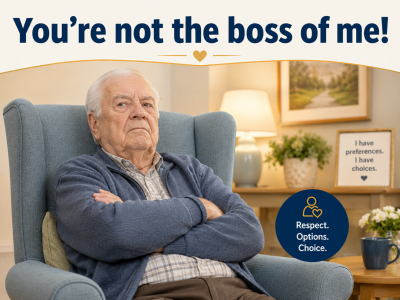
A dementia diagnosis does not cancel adulthood. One of the most damaging mistakes we make in dementia care can happen almost immediately after diagnosis. We forget they are still the boss of themselves.
We decide what the person will wear. What they will eat. When they will get up. Where they will sit. What activity they will attend. When they will bathe. What they are capable of doing. Sometimes we even stop asking.
The reasoning is usually well intentioned. They have dementia. They might make the wrong decision. It is easier if we just do it for them. They cannot remember anyway.
But somewhere along the way, assistance quietly turns into control.
A diagnosis of Alzheimer’s disease or another dementia does not suddenly make a person incapable of doing everything, deciding anything, or having a say in how their own life is lived. Yet that is sometimes how care begins to feel.
It is almost as though we say:
“Now that you have dementia, we will take over.”
And that can pull the rug out from under someone who may already be struggling with enormous losses.
Dementia Is Not Global Incapacity
A person may have difficulty remembering what happened yesterday and still know exactly which sweater they want to wear.
They may no longer be able to manage their finances and still know whether they want coffee or tea.
Perhaps they need help getting dressed and still want to choose what they wear.
They may need assistance bathing and still have strong opinions about the water temperature, the time of day, who helps them, or whether they want to wash their face first or last.
Ability is not all-or-nothing. And neither is decision-making.
The better question is not:
“Can this person still make decisions?”
It is:
“What decisions can this person still make, and what support would help them make them successfully?”
That is a very different mindset.
Make Choice Part of Everyday Care
Resident Choice: Parts One and Two help staff build meaningful choice into everyday interactions — not as an extra task, but as a natural part of how care is delivered.
The goal: keep the resident involved, respected, and still the boss of their own life.
Why Do We Take Over?
Part of the reason is fear.
Families and caregivers worry about safety, mistakes, falls, poor choices, missed medications, wandering, or other risks. Those concerns can be legitimate.
But once we become afraid of risk, it is easy to start removing choice everywhere — even where the risk is minimal.
There is also the pressure of time. It is faster to choose the clothes ourselves.
And it is faster to put breakfast in front of someone; to lead them to an activity; and to complete the grooming task.
But efficiency can come at a very high price when the person begins to experience life as something that is being done to them instead of with them.
Another reason is that we sometimes confuse needing help with being incapable.
They are not the same thing.
A person can require substantial assistance and still retain autonomy.
The Danger of Doing Too Much
When we consistently take over, we may unintentionally teach the person that their participation is no longer required.
We stop giving them opportunities to think, choose, reach, sort, pour, dress, decide, initiate, or contribute.
Then, over time, we may look at the resulting dependence and say:
“See? They cannot do anything for themselves.”
But sometimes we helped create that dependence. Not because anyone intended harm, but because we stopped asking what the person could still do.
We replaced ability with efficiency, choice with routine and participation with completion.
Support the Ability That Remains
Good dementia care should not begin with the question:
“What can I take over?”
It should begin with:
“What can this person still do?”
Then we support that ability. If:
- a person cannot select from an entire closet, show two shirts.
- an open-ended question is confusing, offer two visible choices.
- verbal instructions are difficult, demonstrate.
- the person can complete only part of a task, let them complete that part.
- they need more time, give them more time.
- they say no, pause long enough to understand what the no may mean.
The goal is not independence at all costs. The goal is maximum ability, minimum assistance.
They Are Still the Boss of Themselves
Perhaps this is the point we need to remember most.
The person living with dementia is still an adult.
That adult still has preferences. They still have likes and dislikes, and history, habits, personality, pride, values, routines and opinions. And they still deserve influence over their own life.
There will be times when safety, health, or impaired decision-making requires more support or limits certain options. But those situations should not become an excuse to remove choice from everything else.
The presence of dementia does not give us permission to automatically take over the person’s life.
Our responsibility is not to make every decision for them.
It is to make it easier for them to remain involved in the decisions they can still make.
Because the moment we stop asking, showing, waiting, observing and inviting participation, we risk taking away far more than memory has taken.
Dementia may change how a person makes decisions.
It should not automatically take away their right to have a say.
Keep the Resident in Charge
Resident Choice: Parts One and Two help care teams turn respect for autonomy into everyday practice. The goal is not simply to “offer choices” occasionally, but to build choice into dining, activities, personal care, communication and documentation so consistently that it becomes second nature.
Staff learn how to recognize where control is being lost, how to offer choices in ways the person can understand and respond to, and how to support autonomy even when assistance is needed.
Because the person may need help — but they should still feel like the boss of their own life.
Resident Choice: Parts One and Two are online, live and interactive sessions.