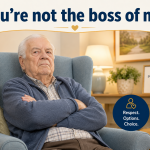

At the case conference, the idea sounded simple enough. “We could place a broom and dustpan in the corner of the dining room,” said the recreation therapist. “Not hidden. Visible. With a small sign that says, Help us keep the home clean.”
She said it the way people do when they think they are suggesting something completely reasonable.
And to her, it was.
She was picturing Mrs. Kelly, who still straightened magazines every morning without being asked. And then there was Mr. Evans, who reached for every napkin on the floor before staff even noticed it. She was picturing all the residents who still looked for work, purpose, and order long after everyone around them had decided they were only there to receive care.
But on the other side of the table, the response was immediate.
“A broom?” one nurse said. “No way.”
A PSW shook her head. “That’s asking for trouble.”
The room shifted.
The recreation therapist looked surprised. “Trouble?”
“Yes,” the nurse said. “A weapon.”
Now the conversation was no longer about contribution, purpose, or community. It was about risk. About what could go wrong. About worst-case scenarios.
And that is often exactly what happens in long-term care.
 One group sees possibility. Another sees danger. One group sees a person who still wants to help.
Another sees an object that has to be controlled.
Neither side is trying to be careless. Neither side is wrong to care. But they are starting from very different assumptions.
The recreation therapist was thinking:
1.What if a resident sees the broom, recognizes it, and feels useful again?
2.What if they sweep a little patch of floor and feel proud?
3.What if this is one more way to say: you still belong here?
The nurse and PSW were thinking:
1.What if someone swings it?
2.What if another resident gets hit?
3. What if we are blamed for leaving it out?
4.What if one unsafe moment wipes out all the good intentions?
So the broom sat in the middle of the discussion as more than just a broom.
It became a symbol.
A symbol of two philosophies that often quietly compete in care settings.
The first says:
Protect people by removing the tools, the risks, the responsibilities, and the opportunities.
The second says:
Support people by adapting the tools, supervising wisely, and keeping open the chance to contribute.
The recreation therapist tried again.
“I’m not saying we leave mops and full cleaning carts everywhere,” she said. “I’m saying some residents still know exactly what a broom is for. Some of them want to help. Some of them are calmer when they have something real to do.”
That part landed with a few people.
Because everyone in the room had seen it.
They had seen the resident who stopped wandering once she was given clean towels to fold.
 >They had seen the man who hovered near the dining room finally settle when asked to wipe tables.
>They had seen agitation dissolve the moment a person was invited into a meaningful role.
Still, the pushback remained.
“It’s different with towels,” someone said. “A broom is different.”
And that was true too.
A broom is different.
Not because it cannot hold meaning, but because it forces the team to confront a harder question:
Are we willing to make space for contribution when it comes with some responsibility to assess, adapt, and supervise? Or do we only support ‘purpose’ when it is tidy, harmless-looking, and easy for staff to accept?
That was the real issue in the room.
Not the broom itself.
The next week, instead of placing a broom openly in the dining room, the team tried something smaller. They chose one resident, Mr. D’Amico, who had spent much of his life caring for his own property and workshop. He was restless every afternoon, often hovering when staff cleaned up after meals. He reached for cloths, pointed out crumbs, and once told a staff member, “You missed a spot.”
So, they tried an experiment.
A staff member approached him after lunch and said, “Would you help us with the floor?”
He took the broom immediately.
Not like a weapon. Like a man who understood exactly what it was for.
He swept slowly. Not perfectly. Not the whole room. But enough. He did enough to make the action clear…changed his posture. Enough to make him look less like a person circling without purpose and more like a person back inside community life.
When he was done, he leaned the broom back against the wall and said,
“There. Better.”
And it was better. Not just the floor. The room. The atmosphere. The way staff looked at him.
Because for those few minutes, he was not a risk to be managed. He was a person contributing to shared life.
That did not mean every resident should be handed a broom. It did not mean judgment disappeared and it did not mean safety no longer mattered. It meant the conversation got wiser.
Instead of asking only, Could this ever be unsafe? the team began asking, How could we do more of this? For whom could this be meaningful? Under what conditions? With what support?
That is the shift. Not reckless freedom. Not blanket refusal. Just thoughtful practice.
And that is often the difference between a care community that only keeps people occupied and one that still allows them to matter.
Join us for this conference: Creating and Presenting Activities Adapted for the Cognitively Impaired – Montessori Dementia Center
or this workshop: Workshop for PSW’s and all Frontline Staff
Disclaimer:
The ideas and examples shared are intended to support thinking and discussion around dementia care practice. They are not prescriptive and have not been reviewed against specific Ministry or regulatory standards. Always align any changes with your organization’s policies, safety protocols, and applicable regulations.