In memory care, one of the most common breakdowns is social recognition. The breakdown happens when people stop using names. Conversations become hesitant. Relationships flatten. That’s why we need name tags in memory care.
The name tag is one of the simplest tools we’ve got to restore that connection but it’s often underused or misunderstood.
Within the Montessori Inspired Lifestyle® approach—and supported by the Center for Applied Research in Dementia—name tags are not about identification for staff convenience. They are cognitive ramps: tools that make it easier for a person living with dementia to access the people around them.
And this starts first and foremost with residents themselves.
Start Here >>> Resident Name Tags Are the Priority
Before we talk about staff, uniforms, or professionalism—this is the key shift:
Resident name tags are not optional. They are foundational.
Why?
Because without them:
- Residents cannot easily recognize or address one another
- Social interaction becomes effortful or avoided
- Opportunities for friendship, humor, and belonging are lost
With them:
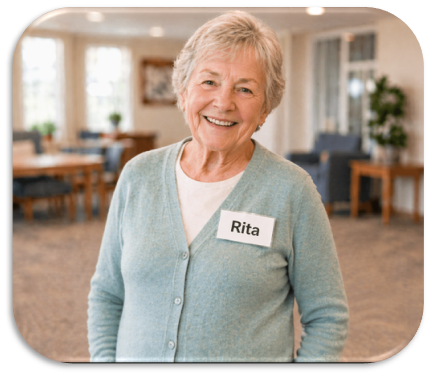
- Residents can greet each other by name
- Conversations become more natural
- The environment becomes socially navigable again
In many homes, residents live alongside dozens of people. Expecting name recall—especially with cognitive impairment—is unrealistic.
Name tags remove that barrier instantly.
What Breaks Without Them
When resident name tags are absent, you often see:
- “Hey you” or no-name interactions
- Staff speaking about residents rather than with them
- Residents withdrawing socially
- Missed opportunities for peer connection
This isn’t a personality issue—it’s an access issue.
Montessori makes it clear:
Don’t test memory. Support it.
Resident name tags do exactly that.
Staff Name Tags: Still Important—But Secondary
Staff name tags absolutely matter—but they serve a slightly different function:
- Help residents identify caregivers
- Build familiarity and trust
- Reduce anxiety (“Who is this person helping me?”)
However, if only staff wear name tags, the environment is still one-directional:
- Residents know staff names
- But not each other
That limits the social fabric of the community.
True Montessori environments support recognition in all directions.
“But This Is Their Home…”
The pushback is common: “We don’t wear name tags at home.”
That argument sounds thoughtful—but it breaks down quickly when you look at function over form:
- In our homes, we don’t live with 20+ people whose names we’re expected to remember despite cognitive impairment—name tags aren’t about ‘institutional feel,’ they’re about restoring access to relationships.
- A name tag isn’t about where you are—it’s about what your brain needs; in memory care, it acts as a cognitive ramp that makes social connection possible, not clinical.
Here’s the reality:
- At home, you live with a small, familiar group
- In memory care, residents encounter many people daily
- At home, recognition is intact
- In memory care, recognition is often impaired
Name tags are not institutional—they are enabling.
They don’t make it feel less like home—they make it more livable.
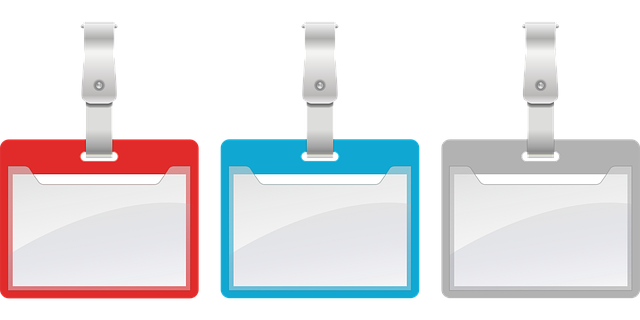
Images are provided for illustrative effect only. They do not constitute recommendations, endorsements, or instructions unless expressly identified.
Design Matters When it Comes to Name Tags in Memory Care
If a name tag can’t be read easily and instantly, it fails—especially for residents. Here are some guidelines.
Font Type: Keep It Clean
Use:
- Arial
- Helvetica
- Verdana
Avoid:
- Script fonts
- Decorative styles
- Branding-heavy typography
Simple = readable.
Font Size: Go Larger Than Feels Normal
- Minimum >>> Minimum: 24–36 pt equivalent
- Ideally readable from 4–6 feet away
For residents especially, bigger is better.
Contrast: Make It Obvious
- Black text on white background works best
- Avoid soft colors, gradients, or patterns
This is not a design contest—it’s a recognition tool.
Content: Focus on the Name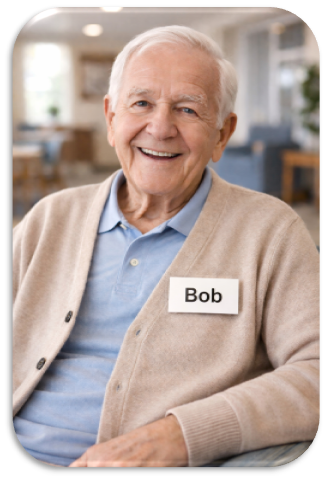
For residents:
- First name is usually sufficient
- Keep it large and centered
For staff:
- First name prominent
- Role optional and smaller
Avoid:
- Clutter
- Long titles
- Pictures – they can differ from current appearance too widely and can become confusing
- Logos overpowering the name – while it is completely understood that logos are important for brand identity, it doesn’t matter so much to your residents. Some homes use one name tag while they are on the floor face to face with residents and a different, branded name tag when in other scenarios.
Format & Placement: Consistency Creates Success
- Horizontal badges are easiest to read
- Place at upper chest level
- Ensure the badge doesn’t flip or hang too low
For residents, consider:
- Comfortable, lightweight options
- Secure but non-intrusive attachment
Consistency across the home allows recognition to become predictable and automatic.
The Real Outcome: Rebuilding Social Life
When resident and staff name tags are used properly, you begin to see:
- Residents calling each other by name
- More spontaneous conversation
- Reduced hesitation and anxiety
- Increased peer interaction (not just staff-dependent engagement)
- A stronger sense of community
This is the shift from:
- “people in a building” to “a recognizable, connected community”
In memory care, we often ask: How do we reduce responsive behaviors?
A better question might be: How do we make the environment easier to understand and navigate?
Resident name tags are one of the simplest, most effective answers.
They don’t just identify people.
They unlock relationships.