

The unspoken expectation that recreation staff should be able to fill every waking hour with meaningful activity is a very real pressure point in long-term care, particularly when it comes to residents living with dementia. Activity directors and life enrichment/recreation teams are often on a hamster wheel they can never step off.
The calendar has to be full.
Morning program. Afternoon program. Evening option.
1:1 visits. Special events. Seasonal themes. Bus outings. Holiday décor.
Family expectations. Documentation.
 Participation dips… the instinct is to add more.Someone seems disengaged… the solution is another activity.If a resident is restless… we look for something to schedule.
But no matter how much is planned, it never feels like enough.
Because the expectation underneath it all is unreasonable:
That residents – people who are going about their lives in their home – should be entertained, stimulated, and exercised all day long — every day.
Who lived like that before they moved into long-term care? No one!
People had roles. Responsibilities. Rhythms.
They cooked. Folded. Paid bills. Helped neighbours. Set tables. Organized cupboards. Watered plants. Hosted. Fixed. Sorted. Contributed.
People weren’t “kept busy.” Their lives required their participation.
When we build a system where engagement depends entirely on staff-created programming, we unintentionally create dependency.
Residents wait for something to start. Staff feel responsible for filling every quiet moment. And when there are gaps — which there always are — everyone feels like they’re failing.
The hamster wheel speeds up.
 Add more themed days.Come up with more entertainment.Let’s go on more outings.More pressure.
But the breakthrough doesn’t come from planning more.
It comes from redistributing meaning. What?
When we say “it comes from redistributing meaning,” we’re describing a shift in where purpose lives inside the home.
In many long-term care settings, meaning is concentrated in staff roles.
Staff plan. They organize. Staff initiate and lead.
Residents receive.
Engagement becomes something delivered. So the burden of meaning — of making the day feel worthwhile — sits almost entirely on the shoulders of the activity team.
That’s heavy. Redistributing meaning means spreading purpose back across the community.
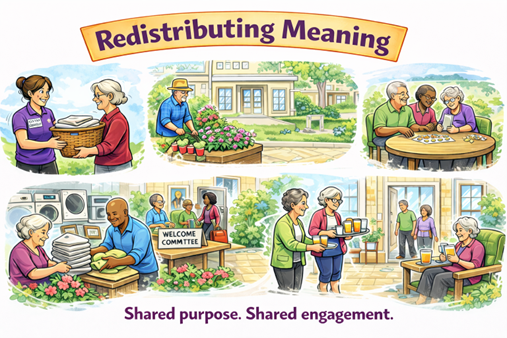
It means:
- Residents prepare, not just attend.
- Residents welcome, not just sit.
- Residents sort, fold, water, organize, assemble.
- Residents contribute to something that matters to others.
When that happens, meaning is no longer centralized in programming. It’s shared.
The activity director is no longer the sole generator of stimulation.
The staff are no longer the sole source of momentum.
Residents are no longer waiting.
Instead of one team trying to create purpose for 100 people, purpose is embedded in daily life — in small responsibilities, committees, roles, rituals, preparation.
You haven’t added more activity. You’ve shifted the structure of the day so that more people hold a piece of it.
That’s what redistributing meaning does:
It moves the question from “How do we fill their time?” to “How do we make them necessary?”
And that changes everything.
Start with a fruit and pastry tray. Seriously.