
“We’ve got to stop trying to manage dementia and start living with it.” That sentence didn’t come from a consultant or a policy document. It emerged from the quiet recognition that something wasn’t working in Swan Manor.
The home was organized. The activity calendar was full. Care plans were thorough. Staff were caring, capable, and often exhausted.
Residents were safe. But many were passive.
The days were structured. The routines were efficient. Interventions were documented. Yet despite all the activity, something essential felt missing.
It wasn’t effort that was lacking. It was orientation.
For years, dementia had been something to manage — symptoms to reduce, behaviors to redirect, risks to control. And while safety and structure matter, management alone does not create life.
The shift began when the question changed.
Not: “How do we manage this?”
But: “How do we live well alongside it?”
You could walk through the dining room mid-morning and see:
- Residents seated with nothing to do.
- Staff rushing between call bells.
- Well-meaning encouragement: “It’s okay, I’ll do that for you.”
Everything was efficient. But very little was empowering.
The leadership committed to making sure the full-team learned all about the Montessori Inspired Lifestyle® — nurses, PSWs, recreation, dietary, housekeeping, even maintenance. It was not a department initiative. It was an organization-wide undertaking.
The focus was simple:
- Every person has strengths.
- Every person can contribute.
- Engagement is not entertainment.
- Independence is dignity.
The first big shift? Staff stopped asking, “How do we keep them busy?”
They started asking, “What can they still do?”
 The Fruit and Pastry Table
One of the first visible changes happened in dietary.
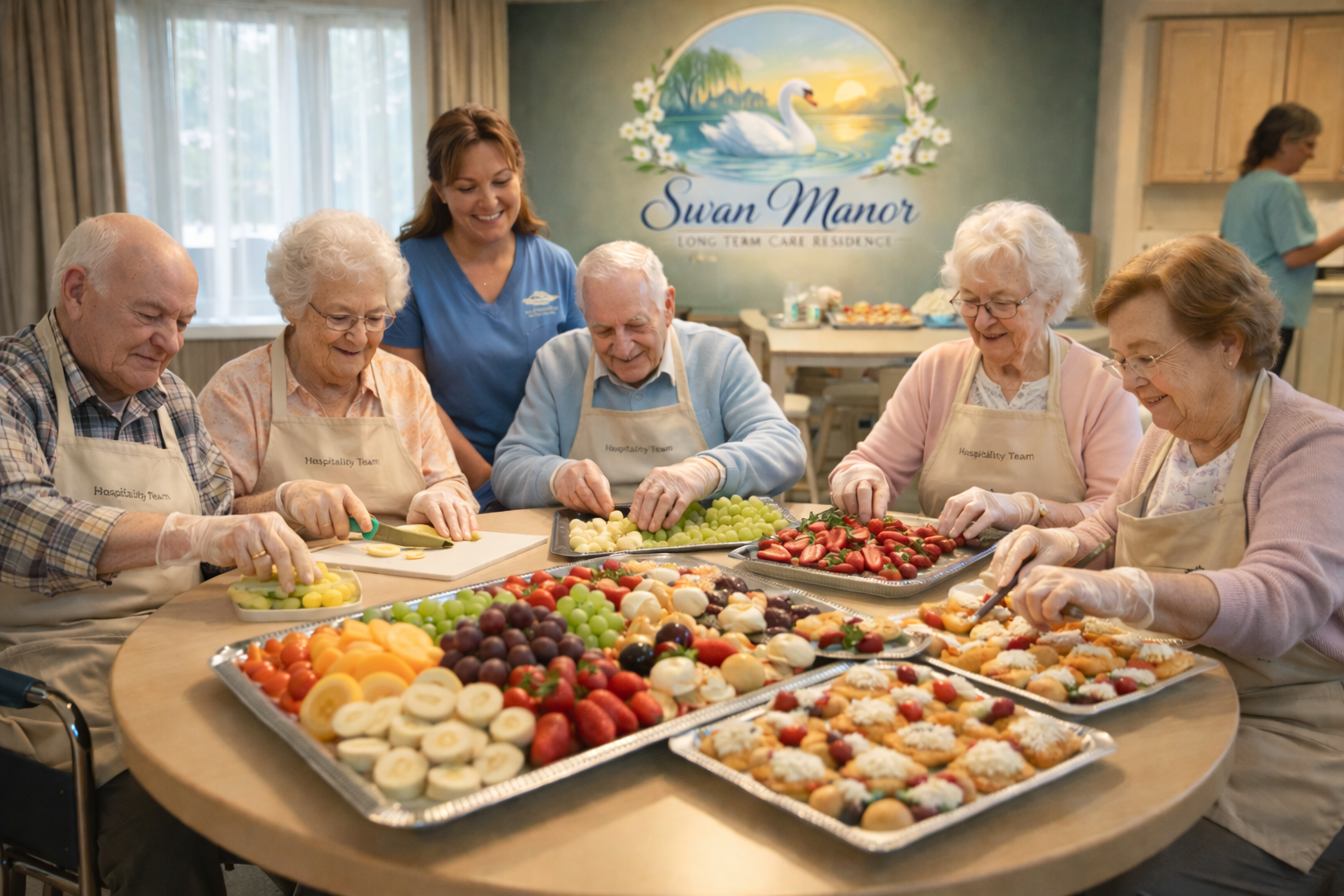
Instead of preparing fruit trays in the kitchen alone, a staff member set up a long table in the common area. She brought out:
- Pre-washed strawberries and grapes
- Bananas and melons partially cut
- Safe, adaptive knives
- Napkins and trays
- Simple visual cue cards showing finished examples
She invited a small group of residents who she believed had the interest and the remaining abilities to “help prepare for the afternoon social.”
At first, a few hesitated.
Then Mrs. K reached for a knife.
Mr. L began arranging grapes in neat rows.
Another resident focused intently on placing melon cubes in a circular pattern, just as he once did in his catering business decades earlier.
The staff member didn’t “take over.” She supervised, modeled and gave short, clear instructions. She offered encouragement only when needed.
For 45 minutes, there were no behavior issues. No one became agitated. There was no repetitive calling out.
There was concentration.
When the trays were later served at the social, the staff made sure to say:
“These were prepared by our residents this morning.”
The pride in the room was palpable…a kitchen committee was formed.
Small Shifts. Big Impact.
After training, staff changed dozens of everyday moments.
Instead of:
Pulling laundry from a cart and folding it alone, they invited residents to sort by color and texture. One former homemaker naturally organized whites from darks. Another paired socks with quiet precision.
Instead of:
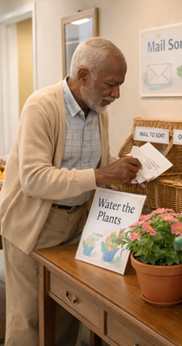
Redirecting people wandering in the hallway, they strategically placed purposeful engagement stations — a watering can and plants, a “mail sorting” basket, a welcome cart for visitors.
Residents who once wandered aimlessly now stopped with intention.
Instead of:
Correcting residents, they used visual cues, step-by-step prompts, and offered choices between two options.
There was less confrontation and more cooperation.
The biggest transformation wasn’t in the environment. It was in the staff.
PSWs reported:
- Feeling less burnt out.
- Experiencing fewer “behavior” escalations.
- Having more meaningful conversations.
One nurse said:
“I used to feel like I was constantly putting out fires. Now I feel like I’m building something.”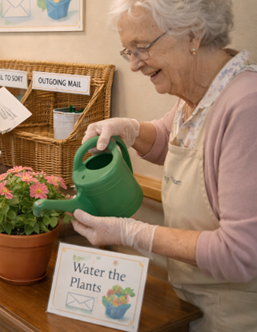
Recreation staff noticed participation rates increase — not because activities were louder or flashier, but because they were purposeful.
Dietary staff began seeing residents as contributors, not recipients.
Even housekeeping found ways to involve residents in simple dusting tasks or towel folding.
The culture shifted from:
Doing for to Doing with
The Ripple Effect
Families began commenting:
- “Mom seems calmer.”
- “Dad looks like himself again.”
- “There’s something different here.”
Call bell frequency decreased. Responsive behaviors and staff sick days decreased.
The home became more alive.
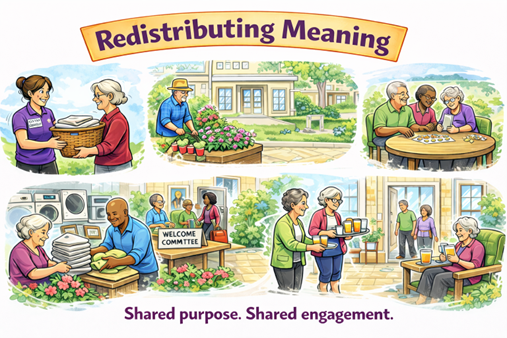
There was conversation, collaboration and shared purpose.
The Real Outcome
Montessori didn’t add more work. It redistributed meaning.
Residents felt needed. Staff felt competent and leadership saw stability.
And the fruit trays kept coming. They were now prepared twice a week when the “Kitchen Help Committee” got together. Later…
The staff had aprons made for them that were labeled:
‘Hospitality Team’
Because that’s what they were. Not patients. They were upstanding citizens taking part in residence life…people with something left to give.
Want to arrange group training for your residence? Click here for details.