
Long-term care environments are structured around tasks: meals prepared, medications administered, rooms cleaned, risks managed. Over time, these tasks accumulate in staff hands, not because residents are incapable of contributing, but because efficiency and protection gradually override participation. The result is subtle but significant — responsibility centralizes, and resident roles shrink. Redistributing meaning challenges that structure. It asks whether our systems are preserving contribution or quietly replacing it.
Redistributing meaning is the intentional shift of purpose, responsibility, and contribution back to the people living within a care environment.
It is not a program, not an activity category, and not a morale initiative. It is a structural decision about where value, function, and ownership reside in daily life.
In many long-term care settings, meaning gradually becomes centralized.
Staff prepare, organize, anticipate, execute, and correct. Residents receive. This pattern rarely develops out of neglect; it grows from efficiency pressures, safety concerns, and the natural human impulse to help.
Tasks migrate toward the fastest and most cognitively intact hands in the room. Over time, however, the environment begins to tilt.
One group does. One group is done for.
Redistributing meaning corrects that tilt.
What Meaning Actually Is
Meaning is often misunderstood in care settings. It’s not entertainment…or stimulation. And it’s not simply “keeping people busy.”
Meaning is contribution that is visible, necessary, and recognized.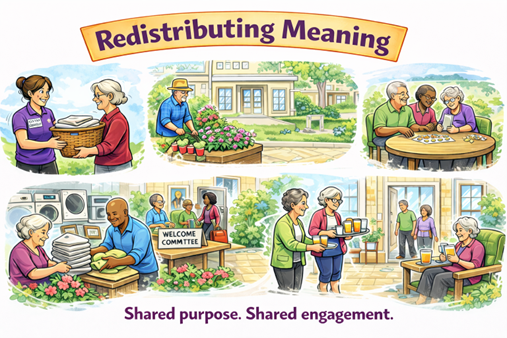
It contains three core elements:
- Purpose — the task serves a real function within the community.
- Ownership — the person understands they are responsible for part of the outcome.
- Impact — the result affects others or the environment in a tangible way.
Without these elements, engagement becomes peripheral. Residents may participate, but they do not carry responsibility. And responsibility is what organizes identity.
When contribution disappears, initiative declines. The day becomes something that happens to a person rather than something shaped by them.
How Meaning Is Quietly Removed
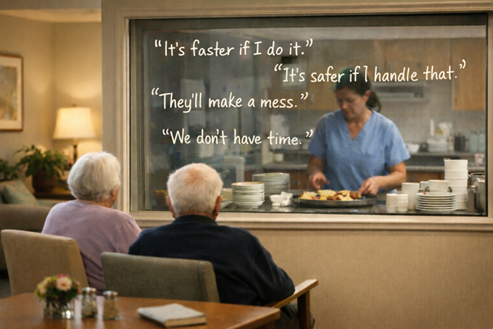
Meaning is most often removed in the name of kindness or risk management.
“It’s faster if I do it.”
“It’s safer if I handle that.”
“They’ll make a mess.”
“We don’t have time.”
Each individual decision seems reasonable. Collectively, they reassign function away from residents. Roles narrow. Tasks disappear. The environment becomes smoother, but thinner.
 When roles disappear, something predictable follows:
- Initiative decreases.
- Restlessness increases.
- Repetitive behavior increases.
- Monitoring and correction increase.
We often attribute these shifts solely to disease progression.
Sometimes they reflect displacement — preserved abilities without a defined place to land.
Redistributing meaning addresses that displacement directly.
What Redistribution Requires
Redistributing meaning does not require new budgets or elaborate programming. It requires structural restraint and intentional design.
The core question is simple:
What are we currently doing for people that they could still be doing — even partially — themselves?
The answer is rarely “everything” or “nothing.” It exists in the middle.
Tasks can be broken down.
Steps can be slowed.
Responsibilities can be shared.
Meals, for example, do not have to be prepared entirely by staff. Residents can set tables, align placemats, fold napkins, pour water using adaptive pitchers, or prepare simple components under safe conditions. Environmental upkeep can include organizing, straightening, sorting, checking, and welcoming. These are not symbolic gestures; they are functional contributions.
Redistribution is not about perfection. It is about participation with real consequence.
The Psychological and Cultural Impact
When meaning is redistributed, measurable shifts occur. Residents show increased regulation. Anxiety decreases because ambiguity decreases. Pride increases because contribution reinforces identity. Correction decreases because engagement increases.
Staff also benefit. Responsibility is no longer centralized and hoarded; it is shared. The emotional tone of the environment stabilizes. The building begins to function less like a service operation and more like a living community.
This is not a sentimental outcome. It is operationally relevant. Environments organized around contribution tend to require less behavioral management.
The Leadership Decision
Redistributing meaning is ultimately a leadership stance. If efficiency is defined narrowly as speed and control, staff will continue to absorb tasks. If participation is defined as a core measure of quality, systems will reorganize around it.
Culture follows what is protected.
If visible resident contribution is valued, time will be allocated for it but if it is treated as optional enrichment, it will collapse under pressure.
Redistributing meaning makes an explicit decision: contribution is not peripheral to care. It is central to it.
The Core Question
Dementia removes certain cognitive capacities. It does not remove the human need to matter.
When meaning is centralized in staff hands, dependence increases beyond what the disease requires. When meaning is redistributed thoughtfully and safely, identity remains active within the limits that still exist.
The guiding question remains straightforward and demanding:
Are we designing systems that protect participation, or systems that replace it?
The answer determines whether a residence functions as a service model — or as a community.
Isn’t it time to look into becoming a Montessori Inspired Lifestyle® Credentialed Residence or Community Organization?