

What is concentration in dementia? “Concentration” doesn’t necessarily mean the same kind of sustained, complex attention an individual without dementia might exhibit.
Instead, it refers to a state of focused engagement on an activity or stimulus that is:
- Meaningful: The activity resonates with the individual’s interests, past experiences, or current emotional state.
- Accessible: The task is within their current cognitive and physical capabilities, avoiding frustration.
- Multi-sensory (often): Activities that engage multiple senses (sight, touch, sound, smell) can be particularly effective.
- Pleasurable: The individual derives enjoyment or a sense of accomplishment from the activity.
This focused engagement can be on a simple task, a sensory experience, or a moment of connection.
How does it “organize the nervous system”?
When an individual with dementia is truly concentrated, several neurological and psychological shifts occur:
Redirection of Attention:
Dementia often causes the brain to become easily distracted, overwhelmed by internal thoughts, or fixated on repetitive loops (e.g., repetitive questioning). Concentration provides a strong external or internal anchor for attention, redirecting cognitive resources away from these disorganized patterns.
Activation of Different Brain Networks:
Engaging in a focused activity, especially one that is familiar or pleasurable, can activate different neural pathways than those involved in anxiety, confusion, or repetitive behaviors. This can lead to a more harmonized brain state.
Reduction of Over/Under Stimulation:
Dementia can lead to challenges in processing sensory information. Sometimes individuals are easily overstimulated, leading to agitation. Other times, they might be under stimulated, leading to boredom, wandering, or seeking out stimulation in disruptive ways. A concentrated activity can provide an optimal level of stimulation, balancing input and processing.
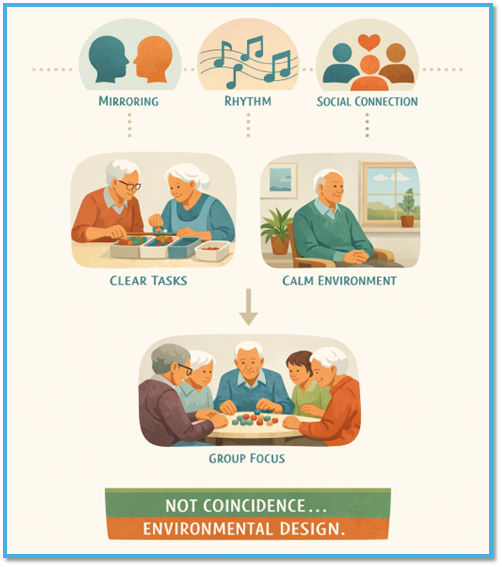
Release of Calming Neurotransmitters:
Engaging in enjoyable and meaningful activities can promote the release of neurotransmitters like dopamine (associated with pleasure and motivation) and serotonin (associated with well-being and calmness). This contributes to a more settled emotional and physiological state.
Sense of Purpose and Control:
Losing cognitive abilities can lead to a profound sense of confusion and lack of control. Successfully engaging in an activity, even a simple one, can provide a momentary sense of purpose, competence, and control, which can be very calming and grounding.
Why do “other things drop away”?
When this concentrated state is achieved:
Repetitive questions pause:
The mind is occupied with the current activity, pulling attention away from the internal loop that generates repetitive questions.
Wandering slows:
The individual is engrossed and has a reason to stay in one place, stopping them from aimlessly searching or pacing due to restlessness or confusion.
Agitation softens:
The underlying anxieties, frustrations, or feelings of being overwhelmed that often fuel agitation are temporarily alleviated by the focus and pleasure of the activity.
The room steadies:
This is an observation from the caregiver’s perspective. The atmosphere in the room becomes calmer and more predictable as the individual’s agitated or restless behaviors subside. It reflects the stabilized internal state of the person with dementia.
In essence, finding ways to facilitate true concentration in individuals with dementia is a powerful non-pharmacological approach to improving their quality of life, reducing challenging behaviors, and promoting moments of peace and connection.