
Why Dementia Behaviors Happen (And What They Really Mean) –
Dementia behaviors are not random. They are often responses to unmet needs, confusion, environmental stress, or communication challenges. Instead of trying to manage behaviors after they occur, understanding the underlying causes—such as discomfort, lack of control, or overstimulation—can help prevent many of them and improve care.
One of the most common questions in dementia care is:
“Why is this behavior happening?”
- A person resists care.
- They repeat the same question.
- They become agitated.
- They call out.
- They wander.
These are often grouped together and labeled as “behaviors.”
In clinical language, they may be called responsive behaviors.
But that label can be misleading.
Because it makes it sound like something is simply happening because of the disease—something unpredictable, unavoidable, or even unexplainable.
In reality, many dementia behaviors are not random at all. They are responses.
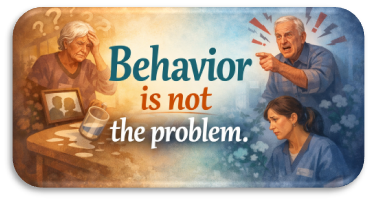 Behavior is Not the Problem
It’s easy to focus on the visible action:
- the refusal
- the agitation
- the repetition
- the resistance
And ask:
👉 “How do we stop this?”
But a more useful question is:
👉 “What is this person responding to?”
Because behavior is often communication—especially when words are no longer available.
This applies across different types of dementia, including Alzheimer’s disease, where changes in memory and language can make it harder for a person to explain what they need.
When communication becomes difficult, behavior often takes its place.
Common Dementia Behaviors (And What They May Mean)
People often search for:
- dementia agitation
- dementia aggression
- dementia wandering
- repetitive behaviors in dementia
These are real and challenging experiences.
But each one can often be linked to something underneath.
Resistance to Care
May be related to:
- feeling rushed
- not understanding what is happening
- lack of control
- fear or confusion
Repetitive Questions
Often linked to:
- anxiety
- need for reassurance
- lack of structure
- difficulty retaining recent information
Agitation or Aggression
Can be triggered by:
- overstimulation
- pain or discomfort
- confusion
- frustration
Wandering
May reflect:
- searching for something familiar
- restlessness
- need for movement
- unmet need for purpose
Calling Out
Can be associated with:
- loneliness
- boredom
- discomfort
- need for attention or reassurance
The Root Causes of Dementia Behaviors
Most dementia behaviors can be traced back to a few core categories.
Understanding these is key.
1. Confusion
Dementia changes how the brain processes information.
A person may not understand:
- where they are
- what is happening
- what is expected of them
Even simple situations can feel overwhelming.
This is especially true in Alzheimer’s, where short-term memory loss makes it difficult to follow ongoing events.
2. Communication Breakdown
When language becomes difficult, people cannot always express:
- pain
- discomfort
- fear
- needs
So instead of saying:
“I don’t understand”
or
“I feel uncomfortable”
They may:
- resist
- push away
- become agitated
3. Loss of Control
Dementia care often involves others making decisions.
Without realizing it, we can:
- give instructions too quickly
- take over tasks
- remove choices
This can lead to:
- frustration
- resistance
- refusal
Because the person is trying to regain control.
4. Environment
The environment plays a huge role.
Too much:
- noise
- clutter
- movement
- stimulation
Or too little:
- structure
- cues
- meaningful engagement
Both can create distress.
5. Lack of Meaningful Engagement
This is one of the most overlooked causes.
When people:
- have nothing meaningful to do
- are excluded from daily life
- are left waiting or sitting
They often become:
- restless
- repetitive
- disengaged
This is where many behaviors begin.
6. Physical Discomfort
Pain, fatigue, hunger, or illness may not be expressed clearly.
Instead, they may show up as:
- agitation
- withdrawal
- resistance
Why “Managing Behavior” Is Not Enough
Many training approaches focus on:
- calming techniques
- redirection
- de-escalation
These are useful.
But they happen after the behavior has already started.
If the same situation keeps happening, then the issue is not just how we respond.
It is what is causing the behavior in the first place.
A Better Approach: Understanding Before Reacting
Instead of asking:
❌ “How do we stop this behavior?”
Ask:
1.What is the person experiencing?
2.What might be confusing?
3.What need is not being met?
4.What in the environment is contributing?
5.How is my approach affecting this?
This shift changes care.
Examples of Preventing Behaviors
A. Instead of: Rushing someone through care
→ Slow down, simplify, use cues
B. Instead of: Giving multiple instructions
→ Use one step at a time
C. Instead of: Correcting or arguing
→ Enter their reality
D. Instead of: Leaving someone disengaged
→ Offer meaningful participation
E. Instead of: Assuming behavior is inevitable
→ Look for what is driving it
Why This Matters
When we understand behavior as communication:
- frustration decreases
- interactions improve
- cooperation increases
- care becomes smoother
And importantly:
The person is seen differently. Not as someone “being difficult,” but as someone responding to something real.
The Bigger Shift
This is not just about managing behaviors.
It is about:
- understanding people
- adjusting environments
- changing communication
- supporting ability
- creating meaning
Dementia behaviors can feel unpredictable.
But many of them are not.
They are signals and responses. And they are attempts to communicate in a world that has become confusing.
When we take the time to understand what is behind the behavior, we move from:
👉 reacting
to
👉 preventing
And that is where dementia care begins to change.

Why do dementia patients become aggressive?
Aggression is often a response to fear, confusion, pain, or loss of control. It is usually not intentional but a reaction to the situation.
What triggers dementia behaviors?
Common triggers include confusion, overstimulation, lack of engagement, poor communication, and physical discomfort.
Are dementia behaviors unavoidable?
Not always. While dementia affects the brain, many behaviors can be reduced by improving communication, environment, and engagement.
How do you calm dementia behaviors?
Calming techniques can help in the moment, but long-term improvement comes from understanding and addressing the underlying causes.