

Understanding Sequencing Difficulties in Dementia: The trouble may be just getting started.
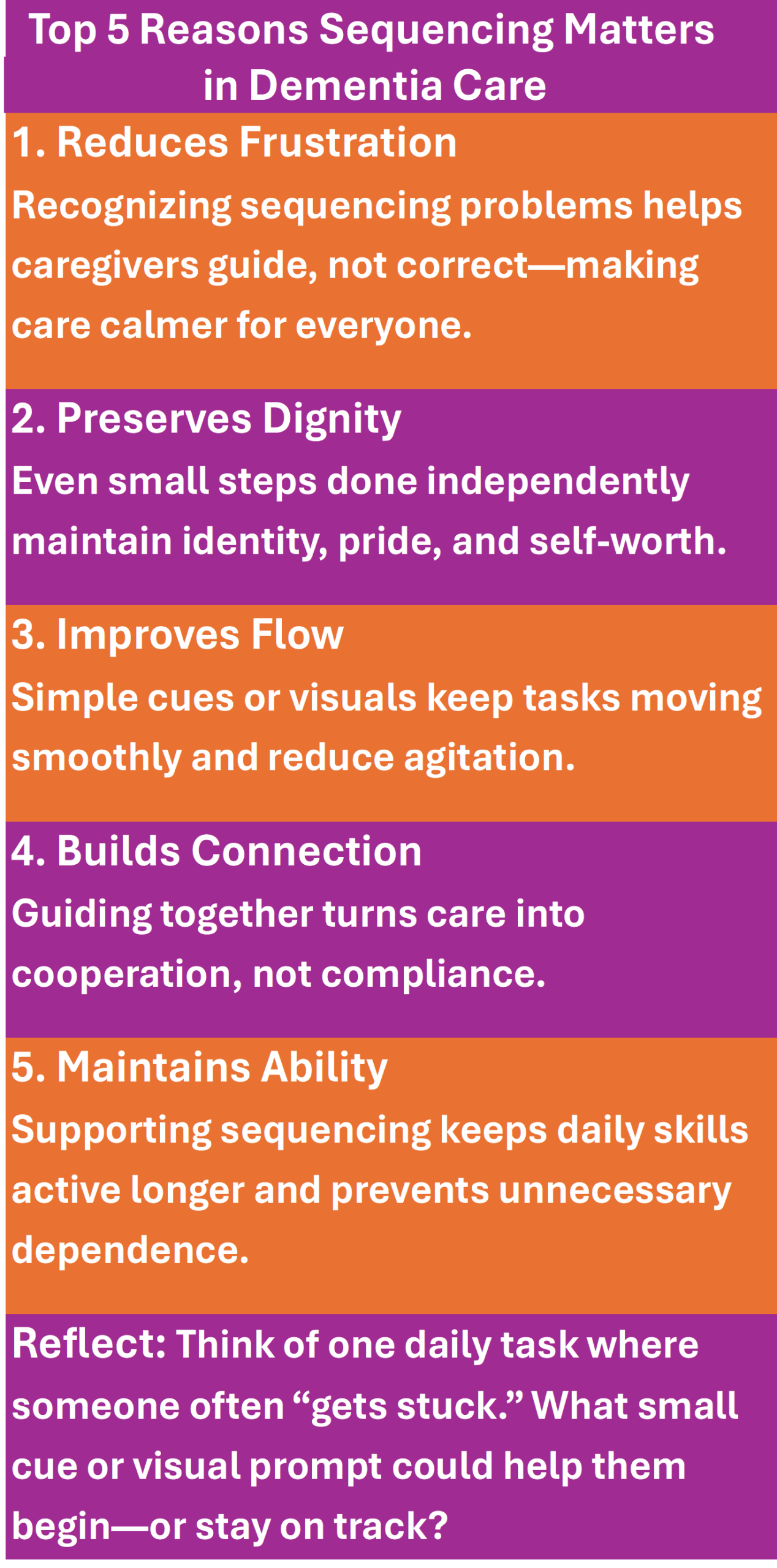
-A person with dementia may have trouble carrying out familiar tasks because the brain can no longer process sequences — the ordered steps that make up an activity. Sequencing is what allows someone to know that before making tea, you must first fill the kettle, then boil the water, then add the tea bag. When this ability is disrupted, the person might skip steps, repeat steps, or get stuck partway through.
Sometimes the difficulty is not in the doing, but in the initiating — getting started. The person may sit in front of a meal but not pick up the fork, or stand at the sink but not begin washing their hands. This doesn’t mean they have forgotten what the task is; rather, they may not be able to activate the first step in the sequence without a cue.
Supportive approaches focus on gentle prompting and visual cues — for example, handing the person the first object (the fork or washcloth), showing the next step through demonstration, or arranging items in the correct order of use. Once the sequence is started, many individuals can continue independently for several steps.
Recognizing this challenge as a problem of sequencing, not stubbornness or disinterest, helps caregivers respond with patience and adapt the environment to support success and dignity.
 Example 1: Trouble Getting Started
Mrs. Li walks into the bathroom and stands in front of the sink. She looks at the running water but doesn’t begin washing her hands. The staff member waits a moment, then gently points to the soap and says, “Here’s your soap, Mrs. Li.” She places the dispenser within easy reach and models pressing it once.
With that small cue, Mrs. Li presses the soap, rubs her hands together, and continues the rest of the handwashing sequence without further help.
What helped wasn’t a reminder to wash her hands, but a cue to begin — something concrete that activated the first step. Mrs. Li completed the sequence independently.
Care Tip: A simple chart above the sink — showing pictures of wet hands → soap → rub → rinse → dry — helps spark recognition of what to do next without waiting for verbal instruction. It acts like a gentle nudge to get the first step underway.
Example 2: Steps Out of Order
 Mr. Harris has brushed his teeth every morning for decades. Today, he picks up his toothbrush and begins brushing without toothpaste. When staff hand him the toothpaste, he squeezes it directly into his mouth instead of onto the brush.
He hasn’t “forgotten” how to brush his teeth. He has lost the ability to organize the steps in sequence.
The caregiver calmly models the steps instead of correcting verbally. She picks up her own brush, applies toothpaste, and gestures toward her mouth. Mr. Harris imitates the motion, smiling as he recognizes the familiar rhythm.
For those who start but lose track of the order of steps you can use one of these: visual sequencing cards or a small laminated chart nearby — 1. Brush → 2. Toothpaste → 3. Brush Teeth → 4. Rinse — serve as an ongoing guide.
These examples show two sides of sequencing difficulty:
- Initiation problems (the person can’t begin the first step), and
- Sequencing errors (the person can’t keep the steps in the right order).
Support with gentle prompts, demonstration, and visual cues that preserve independence and confidence.
Look into Montessori Dementia Training: Principles & Practices for Daily Connection
Or, any of these online sessions:
1.) Resident Choice Is a System, Not a Suggestion
Save 20% by registering for both parts together.⇓
Register for Resident Choice: Part One & Part Two – $88
2.) How to Create & Present Purposeful Activities
3.) How to Form Dementia-Friendly Resident Committees: Where Everyone Belongs