Why Montessori Dementia Care Gets Results – There is an old saying we still use for a reason: the proof is in the pudding.
In other words, the true value of something is not found in how impressive it sounds. It is found in what happens when it is put into practice.
That is exactly why Montessori dementia care matters.
Senior care is filled with approaches, philosophies, training programs and promising ideas. At the end of the day, however, people want answers to a few practical questions. Does it help residents? Does it make care easier for staff? Can it reduce distress, create calmer interactions and improve daily life in ways that people can actually see?
When Montessori dementia care is implemented thoughtfully and consistently, the answer is yes. Its value is not limited to theory or good intentions. It becomes visible in everyday outcomes.
More Than Activities
One of the greatest misunderstandings about Montessori dementia care is that it is simply an approach to activities.
It is much broader than that.
The approach creates conditions in which people are more likely to succeed. Staff learn to notice the abilities that remain, reduce unnecessary confusion and arrange the environment so that it supports greater independence. Meaningful roles replace efforts to merely keep people occupied, while a better understanding of the reasons behind behaviour helps caregivers prevent some and respond more effectively when they still happen.
Over time, these changes influence the entire experience of care.
Calmer Moments Begin With a Better Approach
Care often becomes calmer when staff slow down, simplify their language, approach from the front, offer supported choices and provide clearer cues.
A resident who regularly resisted personal care may become more willing to participate. Someone who became upset during dressing, bathing, mealtimes or transitions may begin to settle more easily. Interactions that once felt tense or unpredictable can become more manageable.
These changes make sense when behaviour is viewed as communication rather than something random or deliberately difficult. Distress may be a response to fear, confusion, overstimulation, loss of control, rushed care or an environment that no longer makes sense to the person.
Montessori dementia care does not begin by asking how to stop the behaviour. It begins by looking at what can be changed around the person. When the approach, expectations and environment improve, the person often does better too.
Building on Abilities That Remain
A traditional view of dementia can become heavily focused on loss. Montessori dementia care begins from a different place by asking, What can this person still do?
That shift changes everything.
Someone may no longer be able to complete an entire task independently, yet still be able to many things such as water plants, polish leaves, wipe a table, arrange flowers, stir batter, match socks, set out napkins or help prepare a room. This list can go on and on.
These are not meaningless tasks offered simply to fill time. They are opportunities to participate, contribute and experience success.
A well-matched role can protect dignity, reinforce identity and reduce the helplessness that comes from having everything done for you. When people are supported to use their remaining abilities, greater engagement, confidence and calm often follow.
Engagement That Feels Personal
Traditional programming often begins by asking what activity can be scheduled. Montessori begins by asking what role or experience would make sense for this particular person.
That difference matters.
Someone who spent a lifetime cooking may respond far more positively to helping in the kitchen than to attending a generic group program. A person who always appreciated order may find comfort in folding laundry, arranging supplies or organizing a drawer. A gardener may become animated around plants, flowers, soil or seed packets, while someone with an office background may engage with sorting, matching, filing or other familiar paper-based tasks.
Stronger engagement does not come from making activities flashier. It comes from making them more meaningful.
People are more likely to participate when an experience feels familiar, achievable and connected to who they are. The activity becomes more than something to do; it becomes a continuation of life, identity and purpose.
Less Pressure on Caregivers
The benefits extend well beyond residents.
When caregivers understand how to set people up for success, they spend less time pushing, correcting, persuading and reacting. Patterns become easier to recognize, triggers become clearer and staff begin to understand which approaches are most likely to work.
Instead of relying on personality or guesswork, the team gains a practical framework. The environment, communication style, pacing, cueing and level of assistance can all be adjusted to make care easier to understand and accept.
This can lead to less frustration and escalation, greater caregiver confidence, stronger teamwork and better communication between shifts. Staff are not being asked to control behaviour. They are learning how to reduce the conditions that contribute to distress.
That distinction makes care both more effective and more humane.
Dignity You Can See
Reduced distress and stronger engagement are important, but dignity matters just as much.
Montessori dementia care continues to recognize the person as an adult. Infantilizing language, childish materials and busy work have no place in an approach built around respect. Life history is honoured, real contributions are encouraged and the enduring needs for usefulness, comfort, belonging and identity are taken seriously.
Memory loss does not erase the desire to matter.
When someone is invited to participate in meaningful life rather than simply being moved through tasks, rooms and schedules, the difference may be visible. The person may smile more, cooperate more readily, remain involved for longer or appear less lost and more anchored.
Sometimes the change is subtle. A person may sit taller, take greater interest in what is happening or begin to initiate part of a familiar routine. Those moments matter because they show that the person is not simply being cared for. They are being supported to remain part of life.
Results Come From Practice, Not Promises
Any model of care can sound impressive on paper. Programs can be filled with appealing language, thoughtful values and ambitious promises.
The real test is what changes in daily practice.
Montessori dementia care does not transform a home overnight, nor does it guarantee that every interaction will be easy. Progress is usually steady rather than dramatic. The environment becomes clearer, the approach becomes gentler and expectations become more realistic. Staff begin offering assistance without taking over, while residents experience more opportunities for participation and success.
The results appear in everyday moments: a calmer meal, a smoother bath, an easier transition or a resident who no longer becomes distressed in the same situation each day. They can be seen in a caregiver who now knows how to approach differently and in a person who is watering plants, delivering notes, setting a table, organizing something or helping in a way that still feels like real life.
The Results Speak for Themselves
Montessori dementia care works because it does not try to control people into behaving differently. It seeks to understand what the person may be communicating and then changes the support, surroundings or approach to make success more possible.
That is a very different way of providing care.
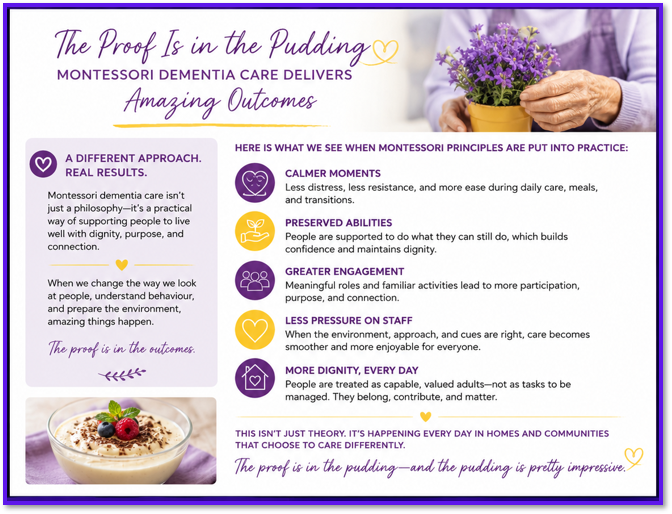
When it is done well, the outcomes are difficult to ignore. Residents experience more purpose, participation and dignity. Caregivers gain practical strategies that reduce uncertainty and frustration. Daily routines become calmer, and the entire team begins to see the person through the lens of ability rather than loss.
So yes, in dementia care as in life, the proof is in the pudding.
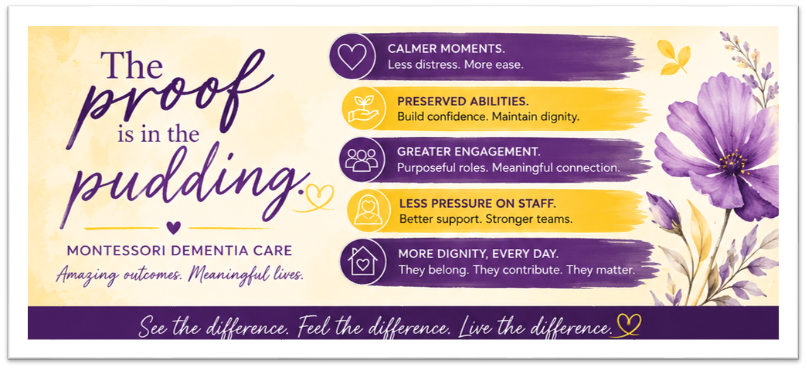
With Montessori dementia care, the proof can be found in the calmer moments, the preserved abilities, the meaningful roles and the people who are once again able to participate in their own lives.
Here are some quick links for you:
10.5 Hours Online (3 x 3.5 Hour Sessions)
1-Day In Person for PSWs, HCAs and Other Frontline Staff
Inquire – Private Group Training – Any Program – Onsite or Online